

What if your rental property could pay you while lowering your taxes — legally?
In many cases, investors cut tens of thousands from their annual tax bills by using a few proven moves.
This post walks through five core tax strategies — depreciation, 1031 exchanges, cost segregation, entity choice, and smart sale timing — so you can boost after-tax returns, avoid surprises, and know what to ask your CPA before you sell.
Follow the simple checklist inside to start saving this year.
Top Tax Strategies for Real Estate Investors (Quick Start Guide)

Real estate investors can cut their annual tax bill by tens of thousands when they know which levers to pull. The IRS lets landlords and property owners deduct ordinary business expenses, speed up depreciation, defer capital gains forever, and structure ownership in ways that drop both income and self-employment taxes.
Five core strategies form the backbone of most solid real estate tax plans. Depreciation lets you write off part of your property’s value each year over 27.5 years for residential rentals or 39 years for commercial buildings, even while the actual market value climbs. 1031 like-kind exchanges let you defer 100% of capital gains taxes when you sell one investment property and buy another, but you’ve got strict 45-day identification and 180-day closing deadlines. Cost segregation studies reclassify building components like flooring, lighting, and HVAC systems into shorter 5, 7, or 15 year depreciation schedules, front-loading deductions and boosting cash flow in the early years. Picking the right legal entity (LLC, partnership, S-corp, or C-corp) controls how income flows to you, whether you pay self-employment taxes, and how well you can shield personal assets. And smart timing of sales plus basis adjustments can reduce or eliminate capital gains taxes, especially when you pair them with installment sales or step-up in basis planning for heirs.
Each strategy needs documentation, planning, and usually professional help to pull off. Lots of investors stack multiple strategies in the same year. They’ll use cost segregation to create big paper losses, structure ownership through an LLC for liability protection, and plan a future 1031 exchange to defer taxes when they eventually sell.
Here’s what every real estate investor should understand:
- Depreciation deductions that cut taxable income every year without spending a dime
- 1031 exchanges to defer capital gains taxes indefinitely across multiple property sales
- Cost segregation studies to speed up depreciation and front-load tax savings
- Entity structuring (LLC, S-corp, partnership) to optimize pass-through taxation and protect your assets
- Capital gains reduction tactics including basis adjustments, installment sales, and long-term holding periods
Understanding Depreciation and How It Lowers Taxable Income

Depreciation is hands down the most valuable tax benefit available to real estate investors. The IRS treats rental buildings as assets that wear out over time, even though real property often goes up in market value. You get to deduct a chunk of the building’s cost every year as a non-cash expense that directly cuts your taxable income.
The Modified Accelerated Cost Recovery System (MACRS) sets the schedule. Residential rental property (single-family homes, duplexes, apartment buildings) depreciates over 27.5 years using the straight-line method. Commercial and nonresidential property depreciates over 39 years. Only the building and improvements can be depreciated. Land doesn’t wear out and can’t be written off. If you buy a $500,000 rental property with $100,000 allocated to land, your depreciable basis is $400,000. Divide that by 27.5 years and you get an annual depreciation deduction of $14,545.
Depreciation starts the month you place the property in service and continues every year you hold it. You claim the deduction on Schedule E of your personal tax return for each rental property. The deduction reduces your taxable rental income dollar for dollar, which can turn a cash-flow-positive property into a tax loss on paper. That shields other income from taxation.
You can depreciate:
- Building structure (walls, roof, foundation) under 27.5 or 39 year schedules
- Appliances and fixtures (refrigerators, stoves, dishwashers) often reclassified to shorter lives via cost segregation
- Improvements and capital expenditures such as new roofs, HVAC replacements, or major renovations
- Landscaping and site improvements which may qualify for 15 year depreciation under certain conditions
Cost Segregation for Accelerated Depreciation
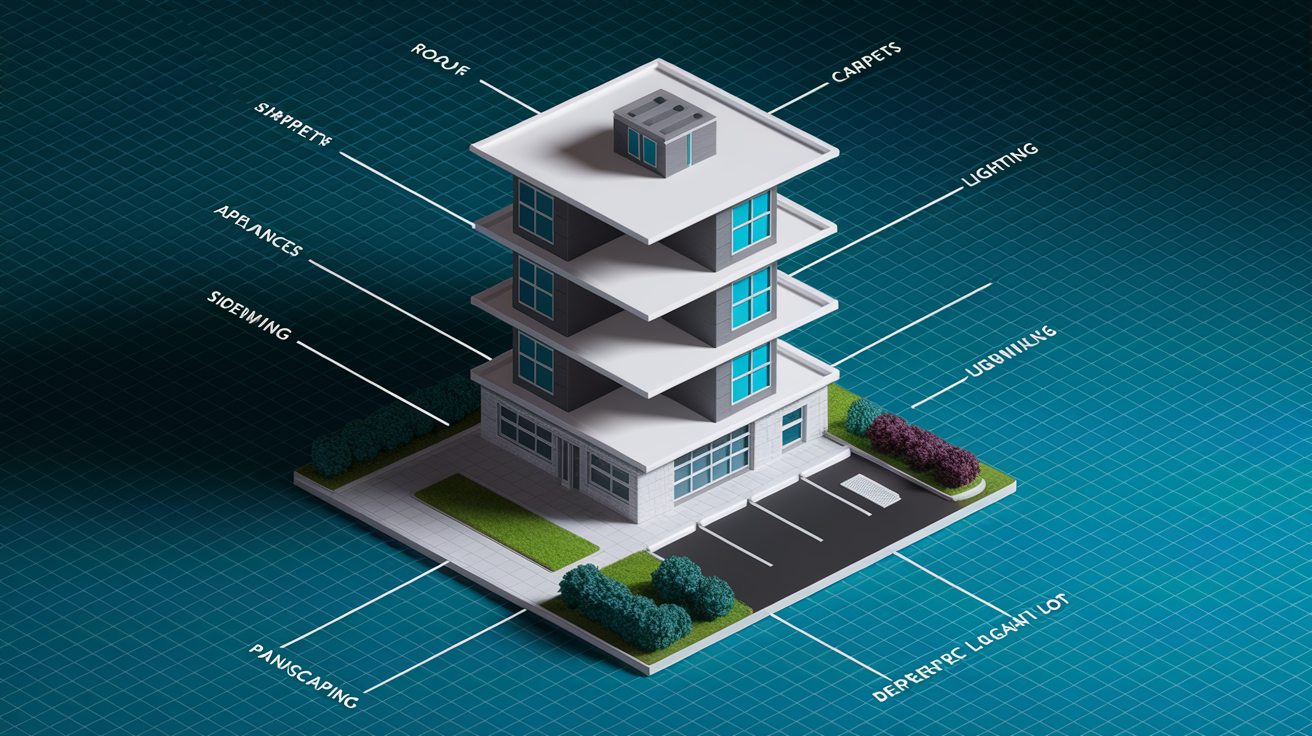
Cost segregation studies break down a building’s purchase price into individual components and reclassify portions from the standard 27.5 or 39 year schedule into much shorter 5, 7, or 15 year asset classes. You get a front-loaded depreciation schedule that generates bigger deductions in the first five to seven years of ownership, improving cash flow and lowering taxable income when you need it most.
A qualified cost segregation engineer inspects the property and allocates costs based on construction details, material invoices, and blueprints. Typical reclassifications include carpeting, cabinetry, electrical wiring for non-structural systems, plumbing fixtures, and specialty lighting. Instead of depreciating these items over nearly three decades, you write them off in five to fifteen years. For a $1,000,000 property with an $800,000 building basis, a cost segregation study might reclassify $200,000 worth of components into shorter lives, producing an additional $30,000 to $50,000 in depreciation deductions during the first few years.
Cost segregation works best on properties valued above $500,000, new construction, and recent acquisitions where the original purchase price is well-documented. The study typically costs $3,000 to $10,000 depending on property size and complexity. But the return on investment often appears within one to three years through tax savings. You can even perform a cost segregation study retroactively using a “look-back” approach and claim missed depreciation via IRS Form 3115, a change in accounting method that doesn’t require amended returns.
| Asset Category | Depreciation Class | Typical Examples |
|---|---|---|
| Personal Property | 5-year | Carpeting, appliances, decorative fixtures |
| Land Improvements | 15-year | Parking lots, sidewalks, landscaping, fencing |
| Building Systems | 7-year or 15-year | Specialty electrical, HVAC components, security systems |
| Building Structure | 27.5-year or 39-year | Walls, foundation, roof, structural framework |
Using 1031 Exchanges to Defer Capital Gains

A 1031 like-kind exchange lets you sell one investment property and buy another without immediately paying federal capital gains taxes or depreciation recapture taxes. The deferred tax becomes a liability carried forward into the replacement property, and you can repeat the process indefinitely, rolling gains across multiple properties over decades.
To qualify, both the property you sell (relinquished property) and the property you buy (replacement property) must be held for investment or productive use in a trade or business. Personal residences and properties held primarily for resale don’t qualify. After the Tax Cuts and Jobs Act, real property exchanges completed after December 2, 2020, are limited to real estate. Personal property such as equipment or vehicles no longer qualifies for 1031 treatment.
The exchange must follow strict IRS timelines. From the day you transfer the relinquished property, you’ve got 45 calendar days to identify potential replacement properties in writing to a qualified intermediary. You then have 180 calendar days from the transfer date (or the due date of your tax return for that year, whichever is earlier) to close on the replacement property. Missing either deadline by even one day disqualifies the entire exchange and triggers immediate tax recognition.
Here’s the full process:
- Engage a qualified intermediary before closing on the sale. Direct receipt of proceeds disqualifies the exchange.
- Sell the relinquished property and transfer proceeds to the intermediary, who holds funds in escrow.
- Identify replacement properties in writing within 45 days. You can name up to three properties of any value, or more under IRS safe harbor rules.
- Close on the replacement property within 180 days using intermediary-held funds to complete the purchase.
- Report the exchange on IRS Form 8824 when you file your tax return for the year of the sale.
Reducing Capital Gains on Real Estate Sales

Long-term capital gains taxes apply when you sell property held for more than one year. The federal tax rate ranges from 0% to 20% depending on your taxable income, with most investors paying 15% on gains. High earners may also owe the 3.8% Net Investment Income Tax on investment gains when modified adjusted gross income exceeds $200,000 for single filers or $250,000 for married couples filing jointly.
You can reduce taxable capital gains by adjusting your cost basis upward before you sell. Basis starts with the original purchase price and increases with capital improvements (new roofs, HVAC replacements, room additions, major renovations) but not routine repairs. Basis also decreases by the amount of depreciation you’ve claimed over the years. When you sell, your taxable gain equals the sale price minus your adjusted basis and selling costs such as broker commissions and legal fees.
Installment sales let you spread gain recognition over multiple years by receiving payments over time instead of a lump sum at closing. You report a portion of the gain each year as you collect principal payments, which can keep you in lower tax brackets and reduce the 3.8% NIIT exposure. But depreciation recapture is generally recognized in the year of sale, even if you use the installment method.
Common strategies for reducing capital gains:
- Increase your cost basis by documenting and adding all capital improvements, legal fees, and acquisition costs to the original purchase price
- Use tax-loss harvesting in the same year to offset gains with losses from other investments or properties sold at a loss
- Hold property for more than one year to qualify for long-term capital gains rates instead of higher ordinary income rates
- Structure installment sales to defer gain recognition over multiple years and potentially stay in lower tax brackets
Choosing the Right Legal Entity for Tax Efficiency

The legal structure you use to hold rental property determines your personal liability exposure, how income and losses flow to your tax return, and whether you owe self-employment taxes on rental income. Most real estate investors choose between single-member LLCs, multi-member LLCs taxed as partnerships, S corporations, and C corporations. Each offers different trade-offs.
Single-member LLCs are disregarded entities for tax purposes. Rental income and expenses flow directly to your Schedule E without a separate tax return. You get liability protection without added complexity, and you avoid self-employment taxes on passive rental income. Multi-member LLCs default to partnership taxation, requiring a Form 1065 partnership return and K-1s for each member, but still offering pass-through treatment and no entity-level tax.
S corporations can reduce self-employment taxes for active real estate professionals by letting you pay yourself a reasonable salary subject to payroll taxes and take remaining profits as distributions not subject to the 15.3% self-employment tax. But S-corps add administrative costs, payroll filings, and reasonable compensation requirements. They rarely make sense for purely passive rental income because rents aren’t subject to self-employment tax in the first place. C corporations face double taxation (once at the 21% corporate rate and again when profits are distributed as dividends), making them unsuitable for most buy-and-hold landlords unless you’re structuring a real estate investment trust or retaining significant earnings inside the entity.
| Entity Type | Tax Treatment | Pros | Cons |
|---|---|---|---|
| Single-Member LLC | Disregarded; flows to Schedule E | Simple filing; liability protection; no self-employment tax on rents | No separation of business and personal tax returns |
| Multi-Member LLC / Partnership | Pass-through; Form 1065 and K-1s | Flexible profit splits; liability protection; avoid double taxation | More complex filings; requires separate partnership return |
| S Corporation | Pass-through with payroll requirements | Can reduce self-employment taxes on active income; K-1 reporting | Payroll filings; reasonable salary rules; added admin costs |
| C Corporation | Entity-level tax at 21%; dividends taxed again | Can retain earnings; clearer separation | Double taxation; rarely optimal for rental income |
Final Words
You’ve got the quick, high‑impact tactics: depreciation timelines, cost segregation to front‑load deductions, 1031 exchange rules, capital‑gains reduction moves, and entity choices that change tax outcomes.
Use the checklists in the post: pull cost basis and depreciation schedules, flag properties for a cost‑seg study, and map any 45‑ and 180‑day timelines before you sign. Do this before you sell.
These real estate investment tax strategies give you a clear, repeatable plan. Prepare records, coordinate with your CPA, and time your moves — you’ll keep more of what you earn.
FAQ
Q: What is the 3 3 3 rule in real estate?
A: The 3 3 3 rule in real estate is a flexible investor shorthand whose meaning varies by context; commonly it’s a quick screening or timeline guideline (tenant notice, rehab, or reserve planning). Check the source.
Q: How to reduce taxes with real estate investment?
A: You reduce taxes with real estate investing by using depreciation, cost segregation, 1031 exchanges, tax-smart entity structures, and long-term holding to shift gains into lower rates; coordinate with a CPA.
Q: What is the most tax-efficient way to buy property?
A: The most tax-efficient way to buy property often is to buy through a pass-through entity (LLC or partnership) for liability and flow-through taxation, then use depreciation and cost segregation; verify with your CPA.
Q: What is the 7% rule in real estate?
A: The 7% rule in real estate usually refers to a quick return or valuation rule-of-thumb—often a target cap rate or expected annual return near 7%; the exact meaning depends on market and context.

