

What if you could pull years of tiny depreciation deductions into the first few tax years?
Most rental buildings get written off over 27.5 or 39 years, so your tax benefit drips out.
Cost segregation flips that.
A study breaks a property into 5-, 7-, and 15-year pieces, like flooring, lighting, and site work, so you claim far bigger deductions up front.
The result: lower taxable income, better early cash flow, and often a study fee that pays for itself.
Thesis: run a qualified cost segregation study with strong documentation to accelerate depreciation and improve short-term returns.
How Accelerated Depreciation Works Through a Cost Segregation Strategy

Without cost segregation, you’re stuck depreciating your rental property on a crawl. Residential buildings get 27.5 years. Commercial? 39 years. Every year, same deduction. The IRS calls this MACRS, and it’s designed to spread your tax benefit so thin you barely feel it when you actually need cash.
Cost segregation flips that script. You bring in engineers and tax specialists to break your building into pieces and reassign those pieces to faster schedules. The structure still sits on that long timeline, but everything else—flooring, lighting, site work—gets moved into 5, 7, or 15-year buckets. More deductions up front. Better cash flow in years one through seven.
Let’s say you bought a property for $1,000,000. A study reclassifies $300,000 into shorter schedules. You’re now claiming way more depreciation in year one than you would’ve under the standard method. That extra write-off cuts your income tax bill and frees up capital you can reinvest or use however you want.
What gets reclassified?
Carpet, vinyl, decorative tile. Usually 5-year personal property.
Cabinets, millwork, appliances. Same deal, 5 years.
Electrical systems tied to specific equipment or tenant spaces. Could be 5 or 7 years depending on what they’re doing.
Paving, landscaping, fencing, sidewalks. Typically 15-year land improvements.
Specialty lighting, security systems, dedicated HVAC units. Often qualify for shorter lives too.
Key Components Reclassified in a Cost Segregation Strategy
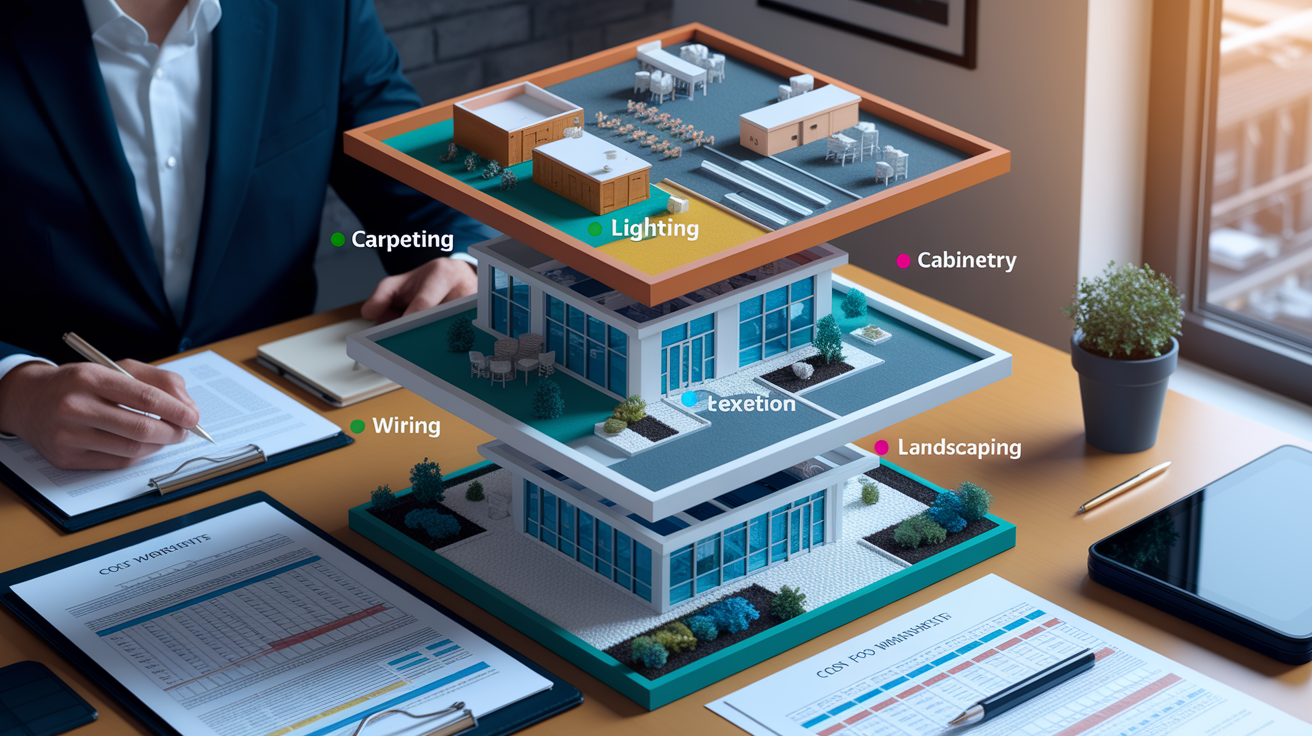
A cost segregation study digs into your property and pulls out everything that qualifies for faster depreciation under IRS rules. The goal? Separate what supports the building from the building itself. Personal property—stuff that isn’t permanently bolted down or serves a specialized function—usually gets a 5-year life. Land improvements like parking lots and landscaping fall into 15 years. The study documents square footage, materials, labor costs, and installation details for each item so you’ve got backup if the IRS comes knocking.
Classification matters because your deductions need real support. A qualified pro will inspect the property, review construction docs and invoices, then allocate costs using accepted methods like detailed engineering or residual estimation. You get an audit-ready report that explains how each component was found, measured, and valued. Skip proper documentation and you’re asking for penalties or disallowed deductions.
| Component Category | Typical Useful Life | Depreciation Class |
|---|---|---|
| Carpeting, vinyl flooring, and decorative finishes | 5 years | Personal property |
| Built-in appliances, cabinetry, and millwork | 5 years | Personal property |
| Specialty electrical circuits and equipment wiring | 5–7 years | Personal property |
| Paving, sidewalks, fencing, and site utilities | 15 years | Land improvements |
| Landscaping, irrigation systems, and exterior lighting | 15 years | Land improvements |
Property Types and Conditions Best Suited for a Cost Segregation Strategy

You can apply cost segregation to any income property, but the payoff scales with value and complexity. General rule: properties worth $500,000 or more produce enough extra depreciation to justify the study cost, which runs $5,000 to $15,000. Below that, tax savings might not cover the fee. Bigger properties—apartments, office buildings, retail centers—have more stuff to reclassify and generate bigger dollar benefits.
Timing counts. The strategy hits hardest on recently acquired, built, or renovated properties. New purchases have a full cost basis to work with. Recent renovations usually include tons of personal property and land improvements. If you’re within the first few years of ownership, a study can still capture most of the near-term benefit. Held a property for a long time without a study? You can use catch-up depreciation via Form 3115, but the immediate cash impact is smaller since you’ve already claimed years of straight-line deductions.
Best candidates:
Multi-family apartments with unit upgrades, amenities, extensive site work.
Single-family rental portfolios with recent rehabs or turnkey buys above the threshold.
Commercial office buildings loaded with tenant improvements, specialized systems, parking infrastructure.
Retail spaces featuring custom build-outs, signage, exterior work, interior finishes.
Step-by-Step Process for Conducting a Cost Segregation Study

A cost segregation study follows a clear process to give you an IRS-compliant report that reallocates your property’s cost basis into shorter schedules.
Hire a qualified firm or CPA with engineering chops. You want people who know both tax code and construction and can back up their classifications if audited.
Gather all your paperwork. Purchase contract, closing statement, construction contracts, architectural plans, invoices, receipts, renovation records. Everything.
Schedule an on-site inspection. The engineer walks the property, takes photos, measures spaces, documents materials to build a detailed asset inventory.
Review the report with your tax advisor. The report lists every reclassified component, its allocated cost, its new schedule. Make sure you understand the classifications and the tax impact before you implement anything.
Update your accounting and tax filings. Reflect the accelerated deductions in your books and attach supporting schedules to your return.
File Form 3115 if you’re doing catch-up depreciation. This IRS form lets you claim missed depreciation as a single adjustment this year without amending old returns.
Documentation protects you. The IRS wants a detailed report that allocates costs using sound engineering and ties back to your original purchase price or construction costs. A thin study raises red flags and can get aggressive classifications tossed. Work with pros who give you itemized reports, calculation worksheets, and photos to support every line.
How Bonus Depreciation Enhances a Cost Segregation Strategy

Bonus depreciation supercharges the near-term tax benefit by letting you take an immediate first-year deduction on a chunk of qualifying assets. Under the Tax Cuts and Jobs Act, property placed in service between September 2017 and December 2022 got 100% bonus on personal property and certain land improvements with lives of 20 years or less. That meant 5, 7, and 15-year assets from a cost seg study could be fully expensed in year one instead of spread over their normal lives.
The 100% rate has phased down. Properties placed in service in 2023 got 80%. 2024 dropped to 60%. Current law sets 40% for 2025, 20% for 2026, zero starting in 2027. Even at reduced rates, bonus depreciation still beats straight-line over 27.5 or 39 years by a mile. Say a study finds $200,000 in 5-year personal property and you place it in service in 2025. You deduct 40% of $200,000—$80,000—right away. The remaining $120,000 depreciates over five years using MACRS.
Bonus usually applies to the reclassified assets, not the building structure. You get a two-tier system: short-life components generate big front-loaded deductions while the building stays on its long schedule. Combined effect? Dramatically lower taxable income in early years. Can even create tax losses that offset other income or carry forward.
Common bonus-eligible assets:
Personal property like appliances, carpeting, window treatments, interior finishes with 5-year lives.
Dedicated electrical and plumbing for specific equipment or tenant spaces (5 to 7 years).
Land improvements: parking lots, sidewalks, fencing, site utilities with 15-year lives.
Qualified improvement property placed in service after the TCJA effective date (certain interior improvements to nonresidential buildings).
Numeric Example: Real Tax Savings from a Cost Segregation Strategy

Here’s what cost segregation looks like in dollars. You buy a multi-family property for $1,500,000 in 2025. Without a study, you depreciate the whole thing over 27.5 years, claiming $54,545 per year. A study reclassifies $150,000 as 5-year personal property and $100,000 as 15-year land improvements, leaving $1,250,000 in the building.
Year one MACRS depreciation gets calculated separately. The $150,000 in personal property depreciates over 5 years at $30,000 per year. The $100,000 in land improvements depreciates over 15 years at $6,667 per year. The remaining $1,250,000 building depreciates over 27.5 years at $45,455 per year. Add those up: $82,122 in MACRS before any bonus.
Now apply 20% bonus to the $150,000 in personal property (using the 2026 rate as a conservative example). Twenty percent of $150,000 is $30,000, deducted immediately in year one. The remaining $120,000 still depreciates over five years. Total first-year depreciation becomes $82,122 in MACRS plus $30,000 in bonus = $112,122. Compare that to the $54,545 you’d have claimed without a study. Incremental deduction: $57,577. At a 35% marginal tax rate, that saves you $20,152 in federal income tax in year one. If the study cost $10,000, you’ve already broken even and generated positive cash flow from tax savings.
| Category | Amount |
|---|---|
| Building Depreciation (27.5 years) | $45,455 |
| Personal Property Depreciation (5 years) | $30,000 |
| Land Improvements Depreciation (15 years) | $6,667 |
| Bonus Depreciation (20% on $150,000) | $30,000 |
| Total First-Year Depreciation | $112,122 |
Larger properties and higher bonus rates multiply these returns. A $3,000,000 property with similar ratios could double the savings. A 60% bonus rate (2024 rules) would add $90,000 instead of $30,000. Run the numbers with your actual purchase price, reclassified amounts, applicable bonus rate, and marginal tax rate to figure out your break-even and decide if a study makes sense.
Risks, Limitations, and Compliance Considerations for Cost Segregation

Accelerated depreciation creates future tax consequences you need to understand before you pull the trigger. The biggest risk is depreciation recapture when you sell. Any depreciation claimed on personal property or land improvements gets recaptured as ordinary income, taxed at your marginal rate instead of the lower capital gains rate. Building structure recapture is capped at 25% under Section 1250 rules, but shorter-life assets face full recapture. That cuts the net benefit if you’re planning to sell within a few years, because you’ll pay back much of the tax savings at closing.
Properties used for personal purposes face extra limits. Vacation homes and short-term rentals where you use the property for more than 14 days or 10% of rental days (whichever is greater) might be treated as personal residences, which limits depreciation deductions. Passive activity loss rules also apply to most rental owners, capping your ability to deduct losses against other income unless you qualify as a real estate professional or meet the $25,000 active participation exception. Weak documentation raises audit risk and can get reclassifications disallowed, triggering penalties and interest on underpaid tax.
| Risk | Explanation |
|---|---|
| Depreciation Recapture on Sale | Accelerated deductions on 5, 7, and 15-year property get recaptured as ordinary income at your marginal rate when you sell, reducing long-term benefit if ownership is short. |
| Personal Use Limitations | Properties with significant personal use might not qualify for full depreciation under vacation home rules, and passive loss limits can cap deductibility against other income. |
| Audit Scrutiny | IRS examiners review cost seg studies closely. Weak documentation or unsupported classifications can result in disallowance, penalties, and interest on deficiencies. |
| Reduced Benefit for Older Properties | Properties held for many years have less remaining cost basis to reclassify, cutting incremental tax savings and making catch-up depreciation less impactful than a study at acquisition. |
When to Use a Cost Segregation Strategy for Maximum Benefit

Best time to do a cost seg study? Right after you buy or substantially renovate a property. Do it in year one and you claim maximum accelerated depreciation from the start, capturing the full benefit of any available bonus. The earlier you reclassify, the more years of front-loaded deductions you get before the property’s useful life runs out or you sell.
You can also do retrospective studies if you’ve owned the property for years without performing a cost seg analysis. The IRS allows catch-up depreciation through an automatic accounting method change filed on Form 3115. This form lets you claim all the depreciation you should’ve taken in prior years as a single adjustment on your current return, no need to amend old filings. Catch-up can still produce real tax savings, but immediate cash flow impact is smaller since you’ve already used some of your cost basis under straight-line.
Timing also matters if you’re planning a sale. A study done shortly before selling creates a large deduction in the final year of ownership, but you’ll immediately face recapture tax on those accelerated deductions when the property closes. Run a break-even to see if short-term tax deferral justifies the study cost and the recapture tax due at closing. Generally, the strategy works best when you plan to hold for at least three to five years, giving you time to benefit from accelerated deductions before recapture becomes due.
Selecting a Qualified Professional for a Cost Segregation Strategy

A cost seg study should be done by someone who knows both tax law and construction engineering. Many specialized firms employ engineers and CPAs who work together to analyze your property, allocate costs, and produce an audit-ready report. Study costs typically run $5,000 to $15,000 depending on property size, complexity, and detail required. Choosing the right pro protects your deductions and gives you the documentation needed to defend your position if audited.
Documentation is everything. A qualified professional gives you a detailed report with property description, site photos, cost allocation worksheets, MACRS schedules, and a narrative explaining the methodology used to classify each component. The report should tie back to your purchase contract, closing statement, and construction invoices so the IRS can trace every dollar from original cost basis to reclassified asset categories. Generic or template-based studies that lack property-specific detail are more likely to get challenged.
What to look for when selecting a cost seg professional:
Engineering credentials and tax expertise. The firm should have licensed engineers or certified cost seg pros alongside CPAs who understand IRS depreciation rules.
Experience with your property type. A firm that specializes in multi-family or commercial real estate will understand common components and classifications for your asset class.
Detailed reporting and documentation. Ask for sample reports to verify they include photos, itemized cost allocations, and clear methodology explanations.
Audit support and defense guarantees. Best firms stand behind their work and will help you if the IRS questions the study during an exam.
Transparent pricing with no hidden fees. Understand full cost upfront and confirm the fee includes the final report, implementation support, and any required follow-up with your tax preparer.
Final Words
You now know how a cost segregation study moves items off the 27.5/39-year schedules into 5-, 7-, or 15-year classes to front-load deductions.
That creates bigger early-year deductions, improves cash flow, and can pair with bonus depreciation for extra savings.
If your property is a recent purchase, major renovation, or valued high enough, consider a cost segregation strategy for accelerating depreciation on rental properties. Hire a qualified specialist, gather purchase docs and plans, and keep the engineering report handy — it often pays off and gives you better control over tax timing.
FAQ
Q: How does cost segregation accelerate depreciation?
A: Cost segregation accelerates depreciation by reclassifying building components from 27.5/39‑year schedules into 5-, 7-, or 15‑year property, producing larger, front‑loaded deductions and improved early cash flow.
Q: Can I do accelerated depreciation on a rental property? / Can you do a cost segregation study on a rental property?
A: You can do accelerated depreciation on a rental property using a cost segregation study. It’s common after purchase, renovation, or new construction, needs an engineering‑style report and may require Form 3115 to catch up prior years.
Q: What is the 50% rule in rental property?
A: The 50% rule in rental property is a rule of thumb that about half of gross rent covers operating expenses (excluding mortgage). Use it for quick budgeting, not as a precise tax or valuation rule.

