

Think moving into a rental for two years wipes out all the tax on your gain?
Not exactly.
You can use the Section 121 home sale exclusion after converting a rental into your primary residence, but the IRS prorates the break for months it was rented and taxes depreciation separately.
Timing, records, and the 2 out of 5 rule decide how much you keep.
This post shows the tests, the math, and the quick steps to plan a conversion that actually saves you money.
Eligibility for Using the Home Sale Exclusion After Converting a Rental
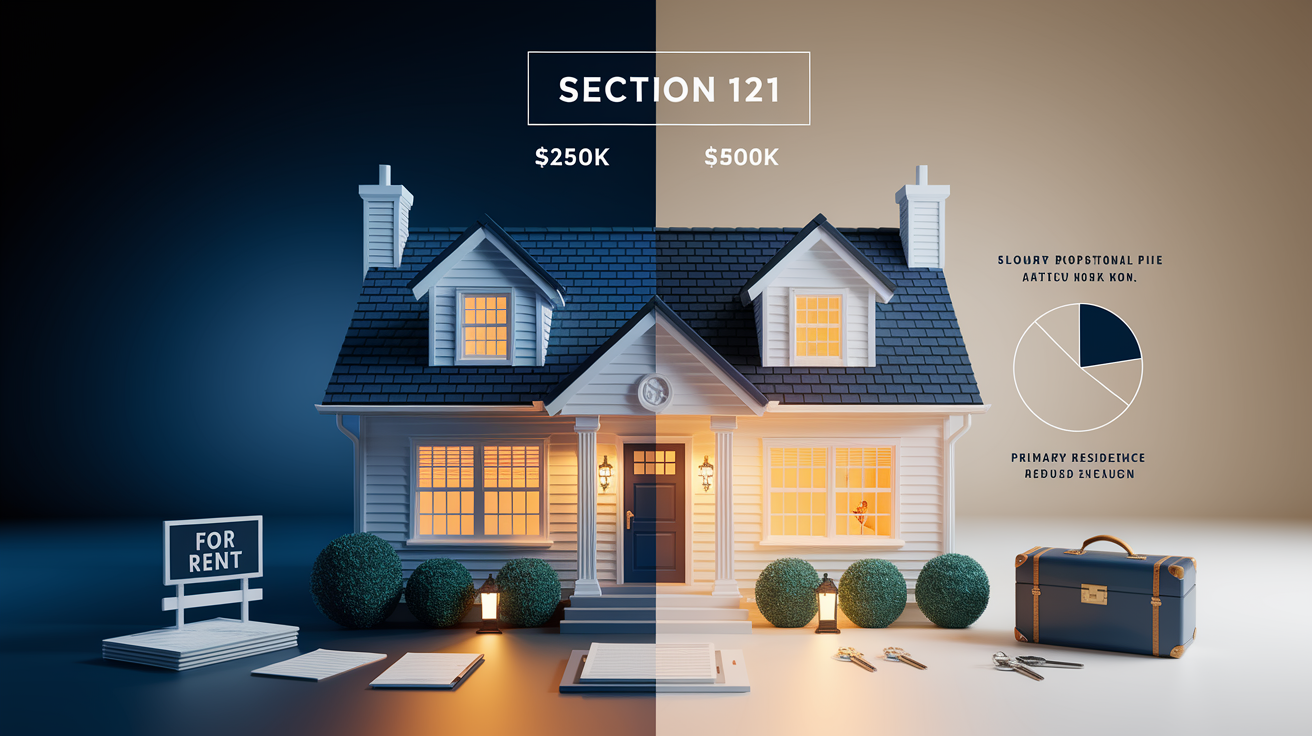
Yes, you can claim the Section 121 home sale exclusion after converting a rental into your primary residence. But you’ll need to meet strict ownership and residency tests, and the exclusion you receive will almost always be reduced. The IRS allows up to $250,000 in capital gains exclusion for single filers and up to $500,000 for married couples filing jointly when you sell a home that was your primary residence for at least two of the five years before the sale. That’s the 2 out of 5 year rule, and it applies whether your property started as a rental or not.
The catch is that any period when the property was rented instead of used as your home counts as “non-qualified use,” and non-qualified use reduces the amount of gain you can exclude. If you owned a property for ten years, rented it for eight, and lived in it for two before selling, you don’t get to exclude the entire $250,000 or $500,000. The IRS will prorate your exclusion based on how many years the property was your actual residence compared to total ownership. That proration can dramatically shrink the tax benefit, especially if you lived there only the minimum two years.
And depreciation recapture is never excluded. Every dollar of depreciation you claimed while renting is taxable on sale, usually at rates up to 25%, no matter how much of your gain is otherwise excluded.
Even with these limits, converting a rental to a primary residence before selling can still save thousands in capital gains taxes compared to selling it as pure rental property. You just need to plan the timing carefully, document your residency clearly, and prepare for the math that splits your gain into taxable and excludable portions.
Core qualification criteria for the home sale exclusion after a rental conversion:
- Ownership test: You must have owned the property for at least two of the five years immediately before sale.
- Residency test: You must have used the property as your primary residence for at least two of those five years.
- Non-qualified use reduction: Periods when the property was rented (or otherwise not your primary residence) after 2008 reduce the exclusion proportionally.
- Depreciation recapture: All depreciation claimed during rental years is taxable upon sale and is not covered by the Section 121 exclusion.
- One exclusion per two years: You can only use the Section 121 exclusion once every two years, so recent prior home sales may disqualify you.
Rules and IRS Definitions That Determine Qualification

The IRS defines your primary residence as the home where you live most of the time and have the strongest connections. Where your mail goes, where you’re registered to vote, where you get your driver’s license renewed. Intent and actual use matter more than title.
To meet the ownership test, you must hold title for at least 24 months during the five year window ending on the sale date. Temporary absences for vacation or seasonal work generally count as time living there, as long as you return.
Non-qualified use is any period after January 1, 2009, when the property was not your primary residence. If you bought a house, rented it for three years, then moved in and lived there for three years, those first three rental years are non-qualified use. The IRS prorates your exclusion by dividing the months of non-qualified use by your total months of ownership. Periods before you bought the property and any temporary absences while you already lived there (like a summer rental during a long vacation) usually don’t count against you. But all intentional rental use after 2009 does.
Depreciation recapture hits every dollar you wrote off while the property was rented. If you claimed $20,000 of depreciation deductions over the rental years, the IRS treats up to $20,000 of your gain as “unrecaptured Section 1250 gain” and taxes it at a rate up to 25%, even if the rest of your gain is excluded under Section 121. You can’t erase depreciation by moving in. It stays on your tax bill.
| Term | IRS Meaning | Effect on Exclusion |
|---|---|---|
| Primary Residence | The home where you live most of the time and maintain legal and personal ties | You must use the property as your primary residence for 2 of the 5 years before sale to qualify |
| Non‑Qualified Use | Periods after Jan. 1, 2009 when the property was not your primary residence (rental, vacant, etc.) | Reduces the exclusion proportionally: exclusion × (qualified months ÷ total months owned) |
| Depreciation Recapture | Depreciation deductions claimed while renting the property | Always taxable at rates up to 25%; not covered by Section 121 exclusion |
| Ownership Test | You must have owned the property for at least 24 months in the 5-year period before sale | Failure to meet the test disqualifies you from any Section 121 exclusion |
Steps Required to Convert a Rental Into a Primary Residence

Converting a rental into your primary residence is partly legal paperwork and partly physical proof that you actually live there. The IRS will accept your claim only if you can show genuine occupancy and intent to make the property your home, not just a quick move in to dodge taxes.
Step by step conversion process:
-
End the rental arrangement. Give your tenant proper notice under local landlord tenant law (typically 30 to 60 days for month to month leases or wait until the lease term expires). Keep copies of termination notices and final move out dates.
-
Physically move in. Occupy the property yourself. Bring your furniture, clothes, and daily belongings. If you’re still living somewhere else after the tenant leaves, the conversion hasn’t really started.
-
Change your mailing address. File a change of address form with the U.S. Postal Service and update your address with banks, credit cards, and any government agencies.
-
Update your driver’s license and vehicle registration. State DMVs typically require proof of residency (utility bills, lease termination, or a deed). This creates a clear legal record of when you moved.
-
Register to vote at the new address. Voter registration is one of the clearest signals of primary residence and is often requested during IRS audits.
-
Switch to homeowner’s insurance. Cancel your landlord or rental dwelling policy and buy an owner occupied homeowners policy. Premiums and coverage will change, and the policy start date proves occupancy.
-
Establish utility accounts in your name. If utilities were in the tenant’s name, transfer them to yours. Keep the first few bills showing your name and the service start date.
-
Gather and file proof of residency documents. Collect utility bills, insurance declarations, bank statements, and any other mail showing your name at the address during your residency period.
Solid documentation is your defense if the IRS questions your conversion. Keep a file with dated proof of every step. Move in date, address changes, lease termination, utility switch overs, insurance policies. And preserve it until well after you sell.
Without it, the IRS may disallow part or all of your exclusion, leaving you with an unexpected tax bill and possible penalties. A clear paper trail showing you actually lived there for at least 24 months in the five years before sale is the foundation of a successful Section 121 claim.
Timing Requirements: Residency, Ownership, and Non‑Qualified Use
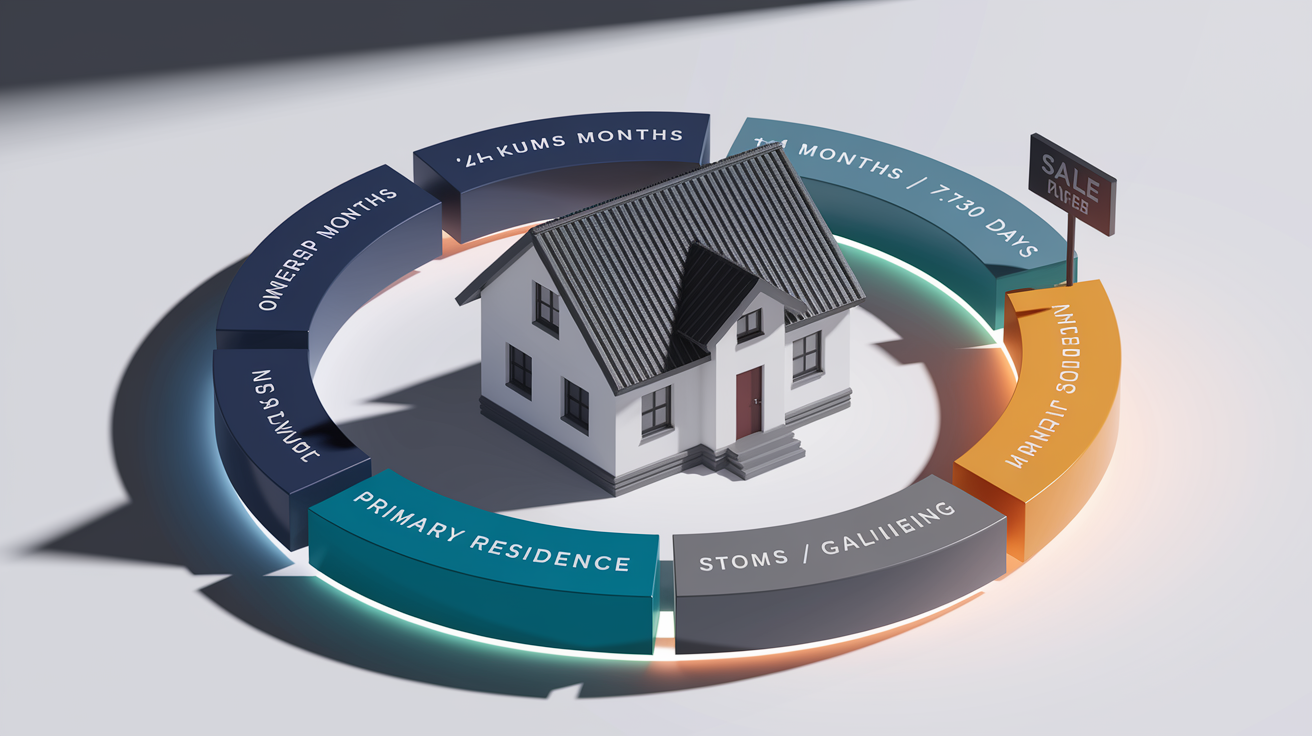
To claim the exclusion, you must meet both the ownership test and the use test during the five year period ending on the date you sell. The ownership test is straightforward: you must have owned the property for at least 24 months (730 days) within that five year window. Ownership doesn’t have to be continuous. If you bought the house, sold it, then bought it back within five years, the IRS will count your total ownership time.
The use test requires you to have lived in the property as your primary residence for at least 24 months during the same five year lookback period, and those months also don’t need to be consecutive. Temporary absences (vacations, short work assignments, medical leave) generally count as time living there as long as you intend to return and do return.
Non-qualified use shrinks your exclusion by the fraction of time the property was rented or otherwise not your primary residence. The IRS formula is: total gain × (non-qualified-use months after 2008 ÷ total months of ownership) = taxable portion of gain not eligible for exclusion.
If you owned a property for 120 months and it was rented for the first 60 months, then you lived in it for 60 months before selling, half of your gain is taxable and half may be excluded (up to the $250,000/$500,000 cap). Periods of non-qualified use before January 1, 2009, are ignored for this calculation, and any period after your last use as a primary residence (if you move out and rent it again before selling) also counts as non-qualified use.
Here’s how timing plays out in common scenarios:
- Scenario 1 (Pass): Owned 6 years, rented 3 years, lived in 3 years, sold. You meet the 2 out of 5 test (3 years of residence in the past 5 years), but half your gain is taxable due to 3 years of non-qualified use.
- Scenario 2 (Fail): Owned 5 years, rented 3.5 years, lived in 1.5 years, sold. You don’t meet the 2 year residency requirement. No exclusion at all.
- Scenario 3 (Pass, reduced): Owned 10 years, rented 8 years, lived in 2 years, sold. You meet the 2 out of 5 test (2 years in the past 5), but 8/10 of your gain is taxable and only 2/10 may be excluded.
- Scenario 4 (Pass, full): Owned 3 years, lived in all 3 years as primary residence, sold. Full exclusion available (up to $250k/$500k) because there was no non-qualified use after 2008.
- Scenario 5 (Fail): Owned 4 years, rented all 4 years, never lived there. No exclusion. Property was never your primary residence.
Calculating the Adjusted Exclusion After Rental Use

The math for a rental to primary conversion gets messy fast because you’re splitting one gain into multiple tax treatments: some excludable under Section 121, some taxable as long term capital gain, and some taxable as depreciation recapture. Start by calculating your total gain (sale price minus adjusted basis, which is original purchase price plus improvements minus depreciation claimed). Then carve out depreciation recapture first. That amount is always taxable and can’t be reduced by the exclusion.
Next, apply the non-qualified-use formula to the remaining gain to figure out how much is excludable and how much is taxable as capital gain.
The non-qualified-use formula is: (Total capital gain after subtracting recapture) × (months of non-qualified use after 2008 ÷ total months owned) = taxable portion. The remainder is eligible for the Section 121 exclusion, up to $250,000 for single filers or $500,000 for married filing jointly. If your eligible exclusion is larger than the remaining gain, you owe no capital gains tax on that portion. If it’s smaller, you’ll owe long term capital gains tax (usually 0%, 15%, or 20% depending on income) on the excess.
Steps to calculate your adjusted exclusion:
- Determine total realized gain. Subtract your adjusted basis (purchase price + improvements − depreciation) from the sale price.
- Separate depreciation recapture. Identify total depreciation claimed during rental years. This amount is taxed at up to 25% as unrecaptured Section 1250 gain and is not excludable.
- Calculate non-qualified-use ratio. Count months of non-qualified use after January 1, 2009, and divide by total months of ownership.
- Apply ratio to remaining gain. Multiply the gain (after subtracting recapture) by the non-qualified ratio to find the taxable portion. The rest is potentially excludable.
- Cap exclusion at $250,000/$500,000. If your excludable amount exceeds the cap, the excess is taxable as long term capital gain.
| Component | Description | Tax Treatment |
|---|---|---|
| Depreciation Recapture | Total depreciation deductions claimed while property was rented | Taxed as unrecaptured Section 1250 gain at rates up to 25%; not excludable |
| Non-Qualified Portion | Gain attributable to months the property was rented or not primary residence after 2008 | Taxed as long-term capital gain (0%, 15%, or 20% depending on income); not excludable |
| Qualified Portion | Gain attributable to months the property was your primary residence | Eligible for Section 121 exclusion up to $250k (single) or $500k (married filing jointly) |
| Excess Gain | Any gain above the maximum Section 121 exclusion limit | Taxed as long-term capital gain at applicable rates |
| Adjusted Basis | Original purchase price + capital improvements − accumulated depreciation | Subtracted from sale price to determine total realized gain |
Real‑World Examples of Conversion and Tax Results

Example 1: Minimal non-qualified use, strong exclusion benefit
You bought a single family home in 2020 for $300,000, rented it for one year, then moved in and lived there as your primary residence for four years before selling in 2025 for $450,000. You claimed $10,000 in depreciation during the rental year and made $20,000 in capital improvements. Adjusted basis = $300,000 + $20,000 − $10,000 = $310,000. Total gain = $450,000 − $310,000 = $140,000. Depreciation recapture = $10,000 (taxed at up to 25%). Remaining gain = $130,000. You owned the property for 60 months. 12 months were non-qualified use. Non-qualified ratio = 12 ÷ 60 = 0.20. Taxable portion = $130,000 × 0.20 = $26,000. Excludable portion = $130,000 × 0.80 = $104,000. Because you’re single and the $104,000 is below the $250,000 cap, you exclude the entire $104,000. You owe long term capital gains tax on $26,000 plus depreciation recapture tax on $10,000.
Example 2: Lengthy rental history, significant non-qualified use
You bought a condo in 2015 for $200,000, rented it for eight years, then moved in and lived there for two years before selling in 2025 for $400,000. You claimed $40,000 in depreciation and spent $10,000 on improvements. Adjusted basis = $200,000 + $10,000 − $40,000 = $170,000. Total gain = $400,000 − $170,000 = $230,000. Depreciation recapture = $40,000. Remaining gain = $190,000. You owned the property for 120 months. 96 months were non-qualified use. Non-qualified ratio = 96 ÷ 120 = 0.80. Taxable portion = $190,000 × 0.80 = $152,000. Excludable portion = $190,000 × 0.20 = $38,000. You meet the 2 out of 5 residency test, so you can exclude $38,000. You owe capital gains tax on $152,000 plus depreciation recapture tax on $40,000. The long rental period eats most of your exclusion benefit.
Example 3: Moderate rental period, married filing jointly, high gain
You and your spouse bought a house in 2018 for $350,000, rented it for three years, moved in and lived there for four years, then sold in 2025 for $700,000. You claimed $30,000 in depreciation and made $50,000 in improvements. Adjusted basis = $350,000 + $50,000 − $30,000 = $370,000. Total gain = $700,000 − $370,000 = $330,000. Depreciation recapture = $30,000. Remaining gain = $300,000. You owned for 84 months. 36 months were non-qualified use. Non-qualified ratio = 36 ÷ 84 ≈ 0.43. Taxable portion = $300,000 × 0.43 = $129,000. Excludable portion = $300,000 × 0.57 = $171,000. Married filing jointly, you can exclude up to $500,000, so you exclude the full $171,000. You owe capital gains tax on $129,000 plus recapture tax on $30,000. The $500,000 cap is high enough that you don’t hit it, but the non-qualified use still costs you tax on nearly half the gain.
| Scenario | Residency Met? | Non‑Qualified Use? | Exclusion Allowed? |
|---|---|---|---|
| Minimal rental (1 year), lived 4 years | Yes (4 years) | Yes (20% of ownership) | Yes, 80% of non-recapture gain excluded |
| Long rental (8 years), lived 2 years | Yes (2 years) | Yes (80% of ownership) | Yes, only 20% of non-recapture gain excluded |
| Moderate rental (3 years), lived 4 years, married | Yes (4 years) | Yes (43% of ownership) | Yes, 57% of non-recapture gain excluded (under $500k cap) |
Common Pitfalls and Compliance Issues
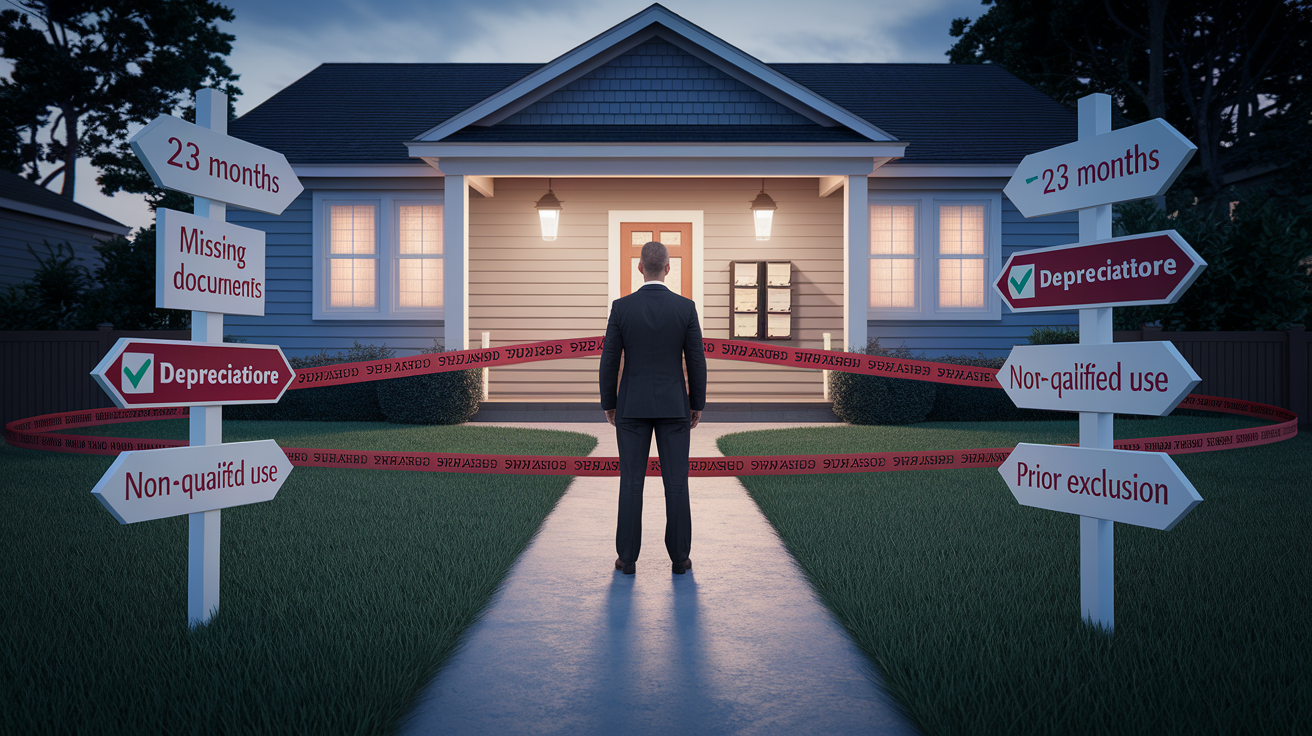
Many taxpayers move into a rental for 18 months, sell, and expect the full exclusion, only to discover they missed the two year mark and owe tax on the entire gain. The IRS counts days, not intentions. If you sell one day short of 730 days of residence, you fail the use test unless you qualify for a partial exclusion due to unforeseen circumstances (job change, health issues, or other IRS approved reasons), and even then the exclusion is prorated.
Another frequent mistake is forgetting that depreciation recapture is never excluded. Homeowners see a $300,000 gain, assume their $500,000 married exclusion covers it, and are shocked when the IRS taxes $40,000 of depreciation at 25%. Recapture comes off the top. Always.
On top of that, many people ignore the non-qualified-use rules entirely, assuming that living in the property for two years wipes the slate clean. It doesn’t. If you rented for six years and lived there for two, the IRS will tax 75% of your gain even though you technically qualify for the exclusion.
Six mistakes that jeopardize the exclusion or increase your tax bill:
- Selling before completing 24 months of residence. Even 23 months disqualifies you unless you meet partial exclusion exceptions (job, health, unforeseen events).
- Failing to document occupancy. No driver’s license change, no utility bills in your name, no voter registration. IRS audits will reject undocumented claims.
- Ignoring depreciation recapture. Depreciation claimed during rental years is taxed separately and is not covered by Section 121.
- Miscounting non-qualified use. Forgetting that rental periods after 2008 reduce the exclusion proportionally. The reduction can be large if you rented for years before moving in.
- Using the exclusion twice in two years. Section 121 allows only one exclusion per two year period. Selling a previous home recently can disqualify you.
- Misreporting or underreporting gain. Mistakes in calculating adjusted basis, forgetting improvements, or omitting depreciation lead to IRS notices, penalties, and interest.
Practical Planning Tips for Homeowners Considering Conversion
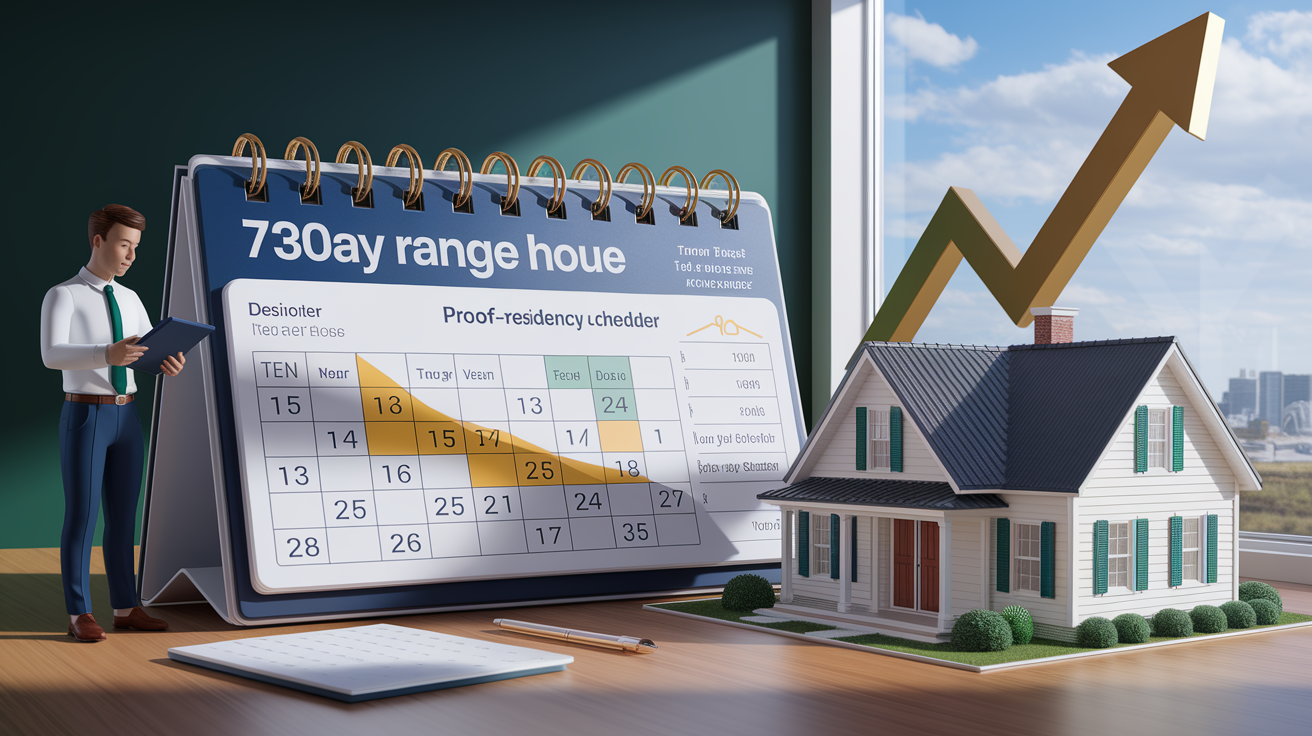
Start planning your conversion years before you intend to sell, not months. If you know you want to move into a rental property and eventually sell it, map out a timeline that gives you at least 24 full months of documented residence before listing. The earlier you convert, the smaller the non-qualified-use fraction and the larger your exclusion.
Five planning best practices for maximizing your exclusion:
- Track your move in date precisely. Document the exact day you physically occupy the property as your primary residence (driver’s license update, first utility bill, change of address confirmation) and count forward 730 days before considering a sale.
- Keep a running depreciation schedule. Know how much depreciation you’ve claimed each year so you can estimate recapture taxes before you sell. Use tax software or your CPA’s records. Don’t guess.
- Preserve all proof of residency. Save copies of utility bills, insurance policies, voter registration, bank statements, and any government correspondence showing your address. Store them in a dedicated folder (digital or physical) labeled “Residence Proof [Property Address].”
- Model the tax impact before listing. Calculate your expected gain, subtract recapture, apply the non-qualified-use formula, and estimate your final tax bill. If the timing isn’t favorable, delay the sale until you hit a better ratio.
- Coordinate timing with life events. If you’re planning a job change, retirement, or another move, align your sale with the periods that qualify for partial exclusions or ensure you’ve completed two full years of residence first.
Timing matters most when you’re balancing market conditions and tax rules. If home prices are climbing and you’re 20 months into residency, waiting four more months to hit the two year mark can save you tens of thousands in taxes, even if the market dips slightly.
On the other hand, if you’re facing a job relocation or urgent liquidity need and you’ve lived there 18 months, running the numbers with a tax professional will show whether the partial exclusion (if you qualify) plus current market value beats waiting. Always compare after tax proceeds, not just sale price, and factor in depreciation recapture and non-qualified-use reductions before making the final call.
Final Words
In short, this guide showed how the two‑out‑of‑five residency and ownership tests work, what non‑qualified use means, and why depreciation recapture matters.
We walked through the practical steps to establish the home as your primary residence, the timing rules, how to calculate a reduced exclusion, real examples, common pitfalls, and planning tips.
If you’re converting a rental to primary residence to qualify for home sale exclusion, gather dates, rental records, depreciation schedules, and talk with your CPA before you sell.
Do this, and you’ll reduce surprises and keep more of your gain.
FAQ
Q: What are the tax consequences of converting a rental property to a primary residence, and can I avoid capital gains if I move into my rental property?
A: Converting a rental to your primary residence can let you claim a partial home‑sale exclusion, but depreciation recapture is always taxable and prior rental use reduces the excluded amount.
Q: How long after a 1031 exchange can you convert to a primary residence?
A: There’s no set IRS waiting period after a 1031 exchange; to use the Section 121 exclusion you must own and live in the property two of the five years before sale, and depreciation still recaptures.
Q: How to avoid capital gains on a primary residence?
A: To avoid capital gains tax on a primary residence, meet Section 121: own and live there two of the five years before sale; rental history and depreciation can reduce or eliminate the exclusion.

