

What if the reason you pay more in tax isn’t the investments you pick, but where you hold them?
Asset location is the simple idea of matching investments to taxable, traditional, or Roth accounts to keep more of what you earn.
Put tax-inefficient assets in tax-deferred accounts, low-tax assets in taxable accounts, and your big-growth bets in Roths.
This post gives clear rules, quick examples, and a simple step-by-step plan to boost your after-tax returns before you sell or rebalance.
Core Principles of Asset Location for Taxable vs Retirement Accounts
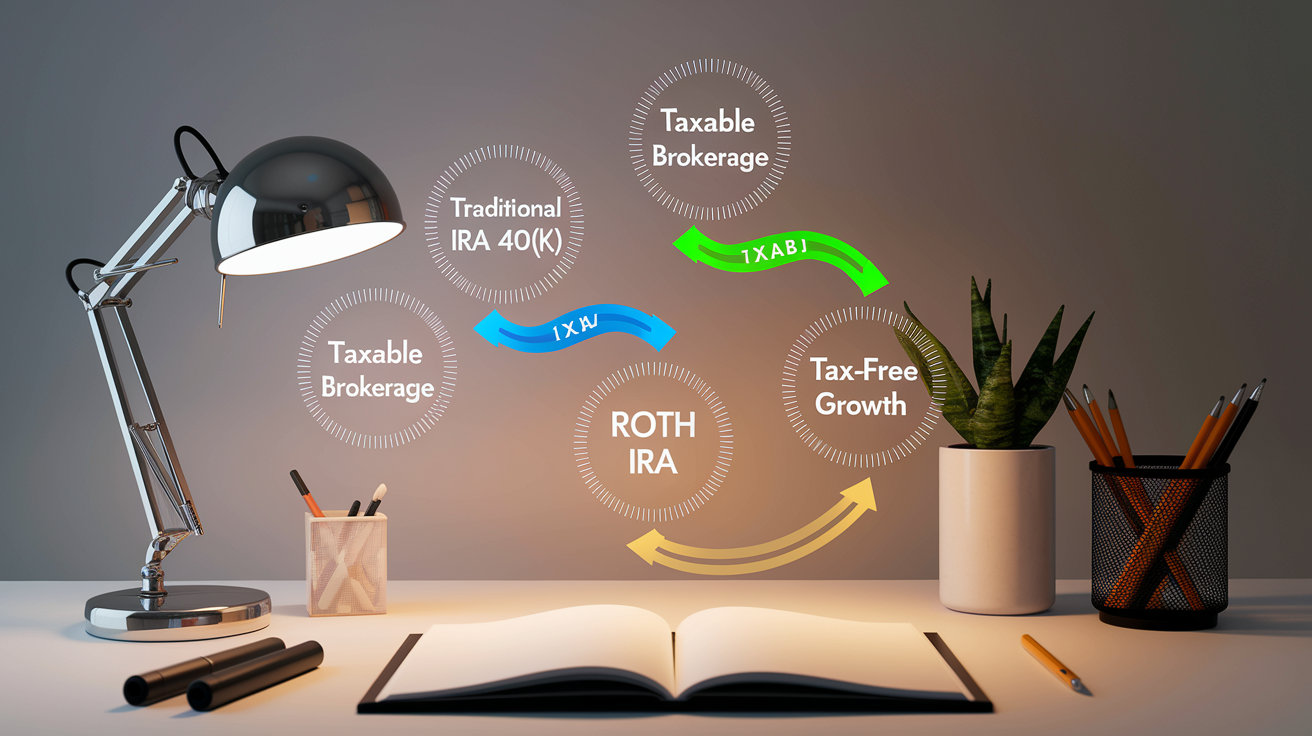
Asset location starts with one thing: different accounts get taxed differently. Match the right investment to the right account and you’ll keep thousands more every year.
Long-term capital gains get taxed at 0%, 15%, or 20% depending on your income. Short-term gains (anything you sell in under a year) get hit at ordinary income rates. Traditional IRA and 401(k) withdrawals? Ordinary income tax, plus a 10% penalty if you’re under 59½. Roth withdrawals are completely tax-free once you’re 59½ and you’ve had the account for five years.
The main rule is pretty straightforward. Tax-inefficient stuff (investments that throw off ordinary income or taxable distributions constantly) goes inside retirement accounts. Tax-efficient assets that don’t create much taxable income during the year belong in taxable brokerage accounts. Roth accounts work best for your highest-upside bets, since all that growth comes out tax-free later.
Quick placement guide:
- Tax-advantaged accounts (traditional IRA, 401(k)): taxable bonds, high-yield bonds, REITs, actively managed stock funds, short-term holdings
- Taxable brokerage accounts: municipal bonds, index ETFs, low-turnover mutual funds, stocks you’re holding long-term
- Roth accounts: growth stocks, high-upside positions, concentrated bets you expect to grow a lot
- Avoid in retirement accounts: municipal bonds (you’re wasting the tax benefit), highly appreciated stocks you plan to pass to heirs (you lose the step-up in basis)
- Avoid in taxable accounts: bonds that generate ordinary interest, actively managed funds, REITs distributing big taxable income
Tax Characteristics That Drive Asset Location Choices

Taxable brokerage accounts let you buy and sell without contribution limits or upfront deductions. But every dividend gets taxed annually and capital gains trigger taxes when you sell. Qualified dividends and long-term capital gains get better rates. Interest and short-term gains get taxed as ordinary income. One upside: if you hold appreciated stocks until you pass away, non-spousal heirs get a step-up in basis that can erase all the capital gains tax on prior appreciation.
Traditional tax-deferred accounts like 401(k)s or traditional IRAs give you tax-deferred growth. Contributions might be pre-tax, nothing gets taxed while the money grows, but every dollar you pull out in retirement is taxed as ordinary income. That means interest, dividends, and capital gains all come out at the same rate. Pull money early (before 59½) and you’re usually looking at a 10% penalty on top of ordinary income tax.
Roth accounts work the opposite way. You contribute after-tax dollars, but qualified withdrawals and all growth are tax-free once you hit 59½ and satisfy the five-year rule. Municipal bond interest is already federally tax-exempt, so holding munis inside a Roth or traditional IRA wastes that benefit. You’d be sheltering income that’s already sheltered.
Asset Location Strategy for Tax-Inefficient Investments

Tax-inefficient assets generate frequent taxable income or distributions taxed at ordinary rates, which creates annual tax hits that slow compounding. Bonds throw off regular interest payments. REITs are required by law to distribute at least 90% of taxable income each year. Actively managed mutual funds churn portfolios, creating short-term capital gains and non-qualified dividends that show up on your tax return whether you sell or not.
All that taxable noise disappears inside a traditional IRA or 401(k), where distributions compound tax-deferred. Or inside a Roth, where they compound tax-free. Placing these assets in retirement accounts means you defer or eliminate the annual tax drag that would otherwise reduce your actual return.
Put these in tax-advantaged accounts first:
- Taxable bond funds and corporate bonds (ordinary interest income)
- High-yield bond funds (higher interest rates, all ordinary income)
- REITs and REIT funds (large annual taxable distributions)
- Actively managed stock funds with high turnover (frequent capital gains distributions)
Think about a taxable corporate bond yielding 4.0% held by someone in the 24% federal bracket. After-tax yield: 4.0% × (1 − 0.24) = 3.04%. Inside a traditional IRA, that 4.0% compounds without annual tax, which matters more over decades. A Roth offers the same deferral plus tax-free withdrawals later.
Asset Location Strategy for Tax-Efficient Investments in Taxable Accounts

Tax-efficient assets create little or no taxable income during the year, delay realization of gains, or produce income taxed at better rates. Broad-market index ETFs generate minimal distributions because low turnover means few capital gains. Municipal bonds produce interest that’s federally tax-exempt. Stocks you’re holding long-term rack up unrealized appreciation that’s taxed only when you decide to sell, and even then at long-term capital gains rates if held over a year.
Taxable accounts also preserve the step-up in basis at death, which can eliminate capital gains taxes for non-spousal heirs inheriting appreciated stocks or index funds. Retirement accounts don’t get that step-up. Beneficiaries pay ordinary income tax on inherited IRA distributions.
| Asset Type | Why It Fits Taxable | Typical Tax Benefit |
|---|---|---|
| Municipal bonds | Interest is federally tax-exempt | No federal income tax on interest; higher tax-equivalent yield for high earners |
| Index ETFs and low-turnover funds | Minimal annual distributions; low realized gains | Long-term capital gains rates (0%, 15%, 20%) instead of ordinary income |
| Individual stocks held long-term | No tax until sale; step-up in basis at death | Deferred realization; favorable LTCG rates; heirs may owe zero tax on prior appreciation |
| Tax-managed mutual funds | Managers actively minimize capital gains distributions | Lower annual taxable events; retain control over realization timing |
When Roth Accounts Offer the Biggest Asset Location Advantage

Roth accounts work best when you expect an asset to deliver large gains over time, because all that growth comes out tax-free in qualified withdrawals. If you’re placing a bet on a concentrated stock position, a high-growth sector fund, or any holding with serious upside, a Roth turns future appreciation into permanently tax-free money once you’re 59½ and past the five-year mark.
Conversions from a traditional IRA to a Roth are taxed as ordinary income in the conversion year. Low-income years offer the best conversion windows: early retirement, between jobs, or a down market. Convert assets you believe will appreciate heavily, lock in today’s tax rate, and let the growth compound without any future tax bill.
Put these in Roth accounts when possible:
- Growth stocks or sector funds expected to outperform significantly
- Concentrated positions or individual stocks with high upside
- Assets that would otherwise generate large taxable distributions in a taxable account (like certain high-dividend equities or REITs you want to hold long-term but also want eventual tax-free access)
Practical Implementation of Asset Location Across Multiple Accounts

Getting your assets into the right accounts takes time. Forcing moves by selling appreciated holdings in a taxable account can trigger a tax bill that erases years of potential savings. Start with new contributions and routine rebalancing rather than wholesale liquidations.
Follow these steps to implement asset location without triggering unnecessary taxes:
- Direct new contributions toward ideal placements. Put your next 401(k) contribution into bond funds or REITs if you’re building tax-deferred accounts. Put your next taxable-account deposit into index ETFs or municipal bonds.
- Rebalance inside retirement accounts first. Trades within a 401(k) or IRA don’t create taxable events, so adjust allocations there when you need to rebalance.
- Use tax-loss harvesting in taxable accounts to free up cash. Sell losing positions to realize losses, offset any gains, and use the freed cash to buy tax-efficient replacements or rebalance.
- Reallocate gradually over time. If you hold bonds in a taxable account and want them in your IRA, wait until you make withdrawals from the taxable account or until you have new IRA contribution room.
- When rolling over a 401(k) after leaving a job, use the opportunity to align asset location. Move bond positions into the rollover IRA and buy index ETFs or stocks in your taxable account with new savings.
The wash-sale rule disallows a tax loss if you buy a substantially identical security within 30 days before or after the sale. When harvesting losses, wait 31 days before repurchasing the same fund. Or buy a similar but not identical fund to maintain market exposure. Example: sell an S&P 500 ETF at a loss, immediately buy a total-market ETF, then swap back after 30 days if you want.
Asset Location Examples: Conservative, Balanced, and Aggressive Portfolios

Real numbers make asset location easier to apply. These examples show how a $500,000 portfolio might be split across account types based on risk tolerance and asset mix.
Conservative Portfolio
A conservative investor might hold 70% bonds and 30% stocks. Place the entire $350,000 bond allocation inside a traditional IRA or 401(k) to shelter ordinary interest income. Use the taxable account for $100,000 in index ETFs or individual stocks held long-term, plus $50,000 in municipal bonds if you’re in a high tax bracket. Growth-oriented stock positions can go in a Roth if you’ve got contribution room.
- $350,000 bonds in tax-deferred accounts (traditional IRA/401(k))
- $100,000 equities (index funds, long-term stocks) in taxable brokerage
- $50,000 municipal bonds in taxable brokerage (or additional equities in Roth if available)
Balanced Portfolio
A balanced 60/40 stock-bond split with $500,000 total might place $200,000 in bonds and REITs inside a tax-deferred account, $200,000 in broad-market index ETFs in the taxable account, and $100,000 in growth stocks or sector funds in a Roth. This setup defers tax on bond interest, preserves long-term capital gains treatment for index positions, and shelters high-upside bets in the Roth.
- $200,000 bonds and REITs in tax-deferred accounts
- $200,000 index ETFs in taxable brokerage
- $100,000 growth equities in Roth accounts
Aggressive Portfolio
An aggressive 90/10 equity-heavy allocation focuses most assets in stocks. Place actively managed stock funds or high-turnover strategies in a tax-deferred or Roth account to avoid annual distribution taxes. Keep $400,000 in tax-efficient index ETFs in the taxable account to benefit from step-up in basis. Use a Roth for $50,000 in concentrated or high-growth positions. The small $50,000 bond allocation can sit in a traditional IRA.
- $50,000 bonds in tax-deferred accounts
- $400,000 index ETFs and long-term stocks in taxable brokerage
- $50,000 high-growth or concentrated positions in Roth accounts
Exceptions, Special Circumstances, and When Rules Change

Asset location rules bend when personal circumstances or tax laws create unusual situations. Stocks held in taxable accounts get a step-up in basis at death for non-spousal heirs, potentially erasing all capital gains tax on appreciation. That makes taxable accounts attractive for estate planning even if the asset is somewhat tax-inefficient during your lifetime.
Required minimum distributions kick in at age 73 (rising to 75 in 2033 under current law), which can force withdrawals from traditional IRAs and 401(k)s regardless of tax efficiency. If large RMDs push you into a higher bracket, consider Roth conversions earlier in retirement. Or place the most tax-efficient assets in taxable accounts to minimize the tax hit when you’re forced to draw down retirement accounts. Municipal bonds become more attractive as income rises, especially for investors in the top federal bracket or those subject to the 3.8% Net Investment Income Tax on modified adjusted gross income above $200,000 (single) or $250,000 (married filing jointly).
Employer 401(k) matches belong in the tax-deferred account by default, so contribute enough to capture the full match before worrying about perfect asset location. State tax rules matter too. Some states don’t tax retirement account distributions, which can shift the calculus. Roth accounts still require the five-year rule even if you’re past 59½, so recent conversions may not be immediately accessible tax-free. And if you’re actively gifting appreciated stock to charity, holding those shares in a taxable account lets you deduct fair market value and avoid capital gains tax. Something you can’t do with IRA assets.
Final Words
Put this into practice: favor retirement accounts for bonds, REITs, and active funds; keep index funds, munis, and long-term stocks in taxable; use Roth for high-upside assets.
You also saw the tax rules that drive these choices: short-term vs long-term rates, ordinary income on traditional withdrawals, Roth rules, and step-up in basis.
Use these asset location strategies for taxable vs retirement accounts as a checklist before you rebalance or sell. Plan ahead, keep records, and ask your CPA when needed. Small steps now can mean noticeably lower taxes later.
FAQ
Q: What is the purpose of asset location and why does it matter?
A: The purpose of asset location is to place investments where their tax rules hurt least, improving after‑tax returns, reducing yearly tax drag, and lowering surprise bills when you sell or withdraw.
Q: Which investments belong in taxable accounts versus retirement accounts?
A: Investments that belong in taxable accounts are tax‑efficient assets (low‑turnover index ETFs, long‑term stocks, municipal bonds); retirement accounts should hold tax‑inefficient assets (bonds, REITs, active funds), with Roths for high‑upside holdings.
Q: How are capital gains, short‑term gains, and dividends taxed?
A: Long‑term capital gains are taxed at 0%, 15%, or 20% based on income; short‑term gains are taxed at ordinary income rates; dividends are taxed annually, with qualified dividends eligible for lower long‑term rates.
Q: How are withdrawals from traditional IRAs/401(k)s and Roth accounts taxed, and what penalties apply?
A: Traditional IRA/401(k) withdrawals are taxed as ordinary income and may face a 10% penalty before age 59½; Roth withdrawals are tax‑free if you’re 59½ and the account has met the five‑year rule.
Q: Why should bonds, REITs, and actively managed funds go in retirement accounts?
A: Bonds, REITs, and active funds belong in retirement accounts because bond interest and many REIT or active fund distributions are taxed as ordinary income, so tax deferral or tax‑free growth avoids annual tax drag.
Q: Why keep index ETFs, long‑term stocks, and municipal bonds in taxable accounts?
A: Index ETFs and long‑term stocks are tax‑efficient due to low turnover and favorable long‑term gain rates; municipal bond interest is often federally tax‑exempt and gains enjoy step‑up in basis at death.
Q: When should I use Roth accounts for high‑growth assets and conversions?
A: You should use Roth accounts for high‑growth assets because earnings grow tax‑free; Roth conversions are useful but trigger ordinary income tax in the conversion year, so plan timing with your tax bracket in mind.
Q: How do I implement asset location across multiple accounts?
A: To implement asset location, first list holdings and tax features, next prioritize tax‑inefficient assets in retirement and high‑growth in Roth, direct new contributions accordingly, rebalance inside tax‑advantaged accounts, and document choices for year‑end.
Q: What should I know about wash‑sale rules and tax‑loss harvesting?
A: The wash‑sale rule disallows a loss if you repurchase a substantially identical security within 30 days; harvest losses in taxable accounts, avoid repurchasing identical investments across accounts during that window.
Q: When do general asset‑location rules not apply or need adjustment?
A: General rules change for RMD timing (age rules moved toward 73–75), employer match needs holding in workplace plans, state tax differences, concentrated stock, charitable strategies, and when step‑up in basis or other estate factors matter.

