

You might be about to pay tax on gains you didn’t earn unless you lock down the asset’s date-of-death value.
Stepped-up valuation means your cost basis becomes the fair market value on the day the prior owner died.
That reset often erases decades of built-in gain, so proving that number matters for every inherited stock and crypto holding.
This post gives a clear, step-by-step checklist: what records to gather, how to pull historical prices, and what to ask your broker or executor.
Immediate Steps to Reconstruct Cost Basis for Inherited Stocks and Crypto

Reconstructing cost basis for inherited stocks and crypto means finding the fair market value on the date the prior owner died. That FMV becomes your new cost basis. It replaces whatever the decedent originally paid. The IRS calls this a “step-up in basis,” and it matters because it usually erases decades of built-in capital gains.
When you inherit stocks or cryptocurrency, you need to lock down the FMV on the date of death before you sell. Without a documented date-of-death value, you can’t calculate your gain correctly. The IRS will assume your basis is zero if you have no records. That means you could pay tax on the entire sale price instead of just your real gain.
Pull together the essential documents right away. Here’s what you need:
- Death certificate showing the date of death.
- Date-of-death fair market value from the brokerage, exchange, or historical pricing tool.
- Account statements from the broker, custodian, or crypto exchange covering the period around the death.
- Wallet export or blockchain record for self-custodied crypto.
- Transaction history or cost basis supplement if the executor already obtained it from the estate.
Start by contacting the brokerage or exchange where the decedent held the assets. Provide the death certificate and any estate paperwork they require. Most custodians will mark the account with the stepped-up basis once they process the transfer. But you should still verify the date-of-death FMV yourself and keep independent proof.
Why Cost Basis for Inherited Stocks and Crypto Is Often Missing or Incomplete

Brokers and exchanges won’t release account information until you submit a death certificate and estate documentation. If the decedent used multiple custodians, offshore exchanges, or self-custodied wallets, each source requires separate paperwork. When estates enter probate, the executor may wait months to access account data. That leaves heirs without the FMV records they need.
Cryptocurrency presents extra obstacles. Decentralized wallets disappear if private keys were never shared. Many people store crypto across hot wallets, cold storage, DeFi protocols, and centralized exchanges without keeping a master list. Executors often discover missing accounts only after scanning email for exchange confirmations or finding hardware devices in desk drawers.
| Cause of Missing Records | Impact on Basis Reconstruction |
|---|---|
| Decedent used multiple brokerages or exchanges | Heirs must contact each custodian separately; some accounts may be overlooked entirely |
| Self-custodied crypto without documented keys | Assets may be permanently inaccessible; FMV cannot be claimed if you cannot prove ownership |
| Estate in probate delaying account access | Executor cannot obtain statements until court issues Letters Testamentary; delays basis documentation |
| Partial or incomplete trade history exports | Beneficiaries must use blockchain explorers or historical price lookups to fill gaps in the record |
How to Reconstruct Cost Basis for Inherited Stocks Using Date-of-Death Valuation

Inherited stock cost basis equals the fair market value on the date of death. If the decedent held 100 shares of a company trading at $90 per share on that day, your basis is $9,000. This is true even if the decedent originally paid $20 per share decades ago. That $90 FMV is what you subtract from your sale price to calculate taxable gain.
Request a historical statement from the brokerage for the month containing the date of death. Most major brokers will provide a date-of-death valuation letter on request. If the account was transferred to a new broker after death, ask the original custodian for archive records. You can also pull historical prices yourself from financial data sites by entering the stock ticker and setting the chart to “all data” or “10 years,” then zooming to the relevant month.
Check for corporate actions between the date of death and your eventual sale. Stock splits, spin-offs, and dividend reinvestment plans can change your share count and complicate your per-share basis. Verify the share total with the broker’s final transfer confirmation and work backward from there.
Here are six reliable sources for historical FMV when reconstructing stock basis:
- Brokerage date-of-death valuation letter or account statement.
- Transfer agent records (for example, Computershare or AST for direct-registered shares).
- Historical closing price from the primary exchange on the date of death (NYSE, Nasdaq).
- Third-party financial data providers (Yahoo Finance, Bloomberg, FactSet).
- The executor’s estate tax return (Form 706) if the estate filed one and documented asset values.
- Archived annual reports or investor-relations data if the stock was thinly traded.
How Stock Splits Affect Inherited Basis
When a stock splits after the date of death, you divide the per-share basis by the split ratio. For example, if your basis was $90 per share and the company executed a 3-for-1 split, your new basis becomes $30 per share. Your share count triples. The total basis stays the same. Always confirm the split date and ratio with the broker before calculating taxable gain.
Dividend Reinvestment Plans (DRIP) and Basis Tracing
If the decedent participated in a DRIP, each reinvested dividend bought fractional shares at the market price on the reinvestment date. Those DRIP shares still receive a stepped-up basis equal to their FMV on the date of death, not the original reinvestment price. The broker or transfer agent should provide a schedule showing all DRIP lots and their date-of-death values. Verify the share totals match the final account transfer to avoid under-reporting basis.
How to Reconstruct Cost Basis for Inherited Crypto Across Exchanges and Wallets

Crypto is treated as property for federal tax purposes and receives the same stepped-up basis as stock. If the decedent bought Bitcoin for $5,000 and it was worth $45,000 on the date of death, your cost basis is $45,000. Selling immediately after inheritance produces little or no taxable gain because your basis resets at the higher FMV.
Start by logging into the decedent’s exchange accounts using credentials from the estate plan or executor. Download CSV transaction history for the entire account. Most centralized exchanges (Coinbase, Kraken, Binance.US, Gemini) let you export all trades, deposits, withdrawals, and balances. Pull the export for the month of death and note the closing balance on that date. Cross-check the exchange’s internal FMV with an independent pricing source to confirm the valuation is reasonable.
For self-custodied wallets, you need the wallet address and access to view the blockchain. If you have the private keys or seed phrase, import the wallet into compatible software and export the transaction log. If you only have the public address, you can still verify holdings and trace history using a blockchain explorer. You don’t need the keys to prove what was owned on the date of death.
Using Blockchain Explorers to Verify Crypto History
Enter the wallet address into a blockchain explorer (Etherscan for Ethereum, Blockchain.com for Bitcoin, Solscan for Solana). The explorer shows every transaction touching that address. That includes balances on any given date. Take a screenshot of the wallet balance on the date of death and save it with your estate records. Blockchain data is permanent and publicly verifiable. It’s strong proof of ownership and value for IRS reporting.
Gathering Exchange Data When Credentials Are Missing
If the decedent never documented exchange logins, check email for account notifications, trade confirmations, or tax documents. Most exchanges send annual tax summaries and 1099 forms. Use those emails to identify which platforms held assets, then contact each exchange’s estate or legal team with the death certificate. Exchanges require formal documentation before releasing records to a non-account holder. Expect multi-week delays while they process your request.
Valuing Thinly Traded Tokens and Obscure Assets
When the inherited crypto is a small-cap or illiquid token, standard exchange pricing may not exist. Use the highest-volume exchange or decentralized exchange (DEX) that listed the token on the date of death. If no reliable price is available, document the best available market data. Note the liquidity issue in your records. Consider obtaining a third-party valuation letter if the holding is large. The IRS expects you to use reasonable FMV. If you can show you made a good-faith effort with the best available data, that typically satisfies reporting requirements.
Here are four acceptable FMV sources for crypto basis reconstruction:
- Centralized exchange closing price on the date of death (Coinbase, Kraken, Binance).
- CoinMarketCap or CoinGecko historical price data for widely traded tokens.
- On-chain DEX price from Uniswap, PancakeSwap, or similar if no centralized listing exists.
- Professional crypto valuation service for large estates or disputed tokens.
Using the Stepped-Up Basis Rule Correctly for Inherited Assets

The stepped-up basis rule resets your cost basis to the fair market value on the date the decedent died. You ignore what the decedent originally paid. The step-up wipes out all unrealized gain that built up during the decedent’s life. It turns a lifetime of appreciation into a tax-free transfer of value.
In some cases, the estate executor can elect an alternate valuation date six months after death if the estate files Form 706. That election applies to the entire estate. It can only be used if it lowers the total estate tax bill. When the alternate date is elected, your stepped-up basis becomes the FMV on that later date instead of the date of death. Confirm with the executor or estate attorney whether an alternate valuation was used before you calculate your gain.
All inherited assets are automatically treated as long-term for capital gains purposes. This is true even if you sell the next day. You never pay short-term capital gains rates on inherited stocks or crypto. That means your gain is taxed at 0%, 15%, or 20%, depending on your income. Not at ordinary rates that can reach 37%.
| Valuation Method | Basis Reset Date | When It Applies | Effect on Your Basis | Executor Action Required |
|---|---|---|---|---|
| Date of Death | Decedent’s date of death | Default rule for all inherited property | Your basis = FMV on death date | None; applies automatically |
| Alternate Valuation | Six months after death | Only if executor files Form 706 and elects alternate date | Your basis = FMV on alternate date | Executor must make election on Form 706 |
| No Step-Up | Not applicable | Retirement accounts (IRA, 401(k)), lifetime gifts, certain irrevocable trusts | Basis remains decedent’s original cost or special distribution rules apply | Confirm asset type; step-up does not apply |
| Step-Down | Date of death | Asset declined in value between purchase and death | Your basis = lower FMV at death (a loss built in) | None; IRS adjusts basis downward automatically |
| Community Property | Date of death | Married couples in community property states; both halves may receive step-up | Entire asset may reset, not just decedent’s half | State law determines; confirm with estate attorney |
How to Verify and Document FMV for Inherited Stocks and Crypto
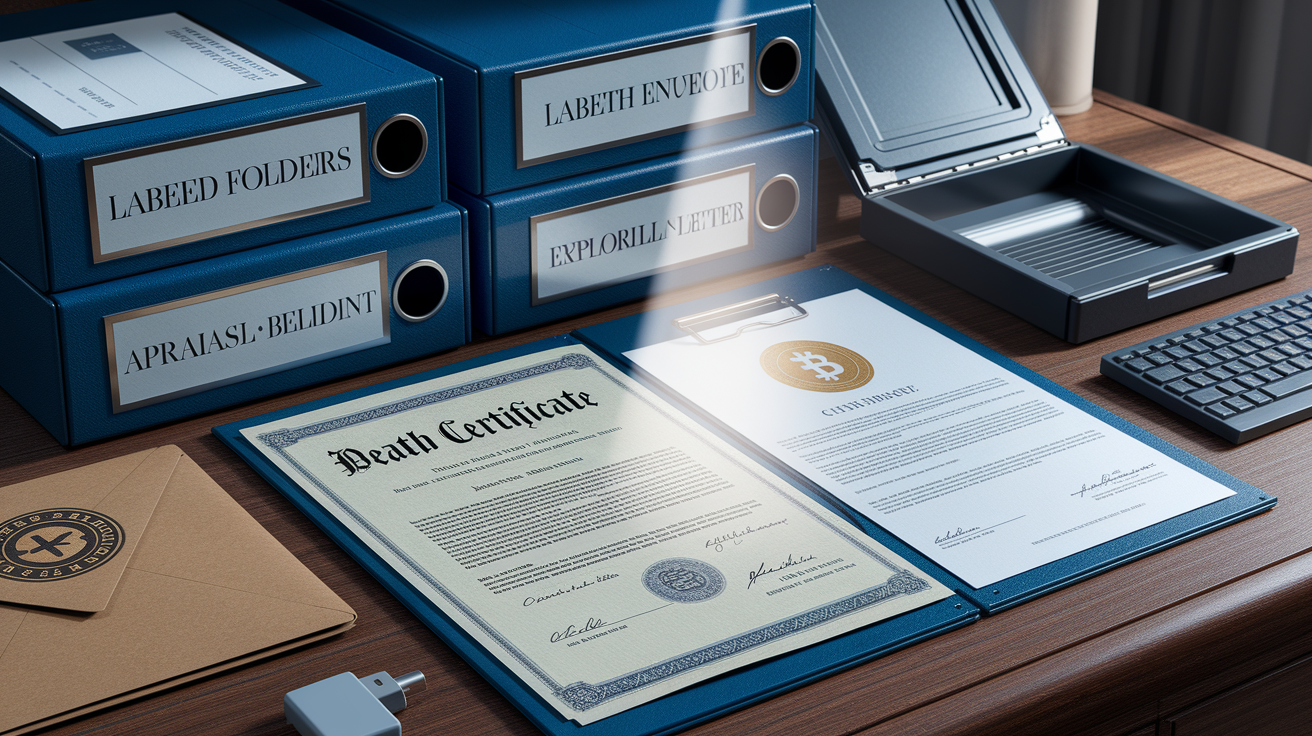
Gather independent proof of the fair market value before you sell. Relying solely on a broker’s cost basis entry can backfire if the broker made an error or never received the correct date-of-death information. Pull your own records and keep them with your tax files in case the IRS asks you to substantiate the stepped-up basis years later.
For stocks, save the brokerage statement showing the account value on or near the date of death. Also grab a screenshot or printed confirmation of the stock’s closing price from the primary exchange. For crypto, export the wallet balance or exchange statement for the date of death, and capture the closing price from a reputable pricing source like CoinMarketCap or the exchange itself. Store these documents together with the death certificate and estate transfer paperwork.
Verification checklist for heirs:
- Death certificate showing official date of death.
- Brokerage or exchange account statement covering the date of death.
- Screenshot or printed record of closing price from the exchange or financial data provider.
- Wallet export or blockchain explorer screenshot for self-custodied crypto.
- Estate tax return (Form 706) if filed, showing asset valuations.
- Independent appraisal or valuation letter for thinly traded, privately held, or disputed assets.
| Documentation Type | What It Proves | Where to Obtain It |
|---|---|---|
| Brokerage valuation letter | Official date-of-death FMV per custodian records | Request from the brokerage estate services team |
| Blockchain explorer screenshot | Wallet balance and transaction history on the date of death | Etherscan, Blockchain.com, Solscan, or chain-specific explorer |
| Third-party valuation report | Independent FMV for illiquid or disputed assets | Hire a qualified appraiser or crypto valuation service |
Reporting Reconstructed Cost Basis to the IRS After You Sell

When you sell inherited stock or crypto, you report the sale on Schedule D and Form 8949. Enter the date you sold, the sale proceeds, your stepped-up cost basis, and the resulting gain or loss. The IRS will cross-check your reported basis against any Form 1099-B the broker issued. Make sure the broker’s records match your date-of-death valuation before you file.
Brokers usually issue a Form 1099-B for stock sales. That form shows the sale price and may show a cost basis. But the basis is often wrong for inherited shares if the broker never received proper estate paperwork. Crypto exchanges may issue a 1099 for large sales, but many do not. Either way, you’re responsible for calculating and reporting the correct basis. If the 1099 shows an incorrect basis or leaves it blank, you override it on Form 8949 and attach an explanation if necessary.
On Form 8949, mark the box indicating the transaction was reported on a 1099 (if applicable) or not reported. Enter the stepped-up basis in the cost basis column. The IRS treats all inherited assets as long-term, so the gain flows to the long-term section of Schedule D automatically. Your taxable gain equals sale price minus stepped-up basis. If you sold at a loss, you can deduct it against other capital gains or up to $3,000 per year against ordinary income.
Steps to report the sale correctly:
- Confirm the stepped-up basis using your date-of-death records before you sell.
- Compare the broker’s 1099-B cost basis to your documented FMV. Correct any errors with the broker before filing.
- Complete Form 8949, entering the sale date, proceeds, stepped-up basis, and gain or loss for each lot.
- Transfer the totals from Form 8949 to Schedule D, ensuring the gain appears in the long-term capital gains section.
Preventing Future Basis Reconstruction Problems for Heirs

Keep a running record of all taxable accounts, wallet addresses, and access credentials in a secure, updatable document. Share the location of that document with your executor or a trusted family member. Include the login details, two-factor recovery codes, and the approximate value of each account so heirs know what to look for.
For crypto, store private keys and seed phrases in a fireproof safe or secure password manager. Make sure your estate plan explicitly mentions digital assets. Without access instructions, heirs may never recover self-custodied holdings. One missing hardware wallet can wipe out six figures of value that would have received a stepped-up basis if only someone knew it existed.
Five preventive steps to protect your heirs:
- Maintain a master list of all brokerage, exchange, and wallet accounts with current login credentials.
- Store private keys and seed phrases in a secure location and document that location in your estate plan.
- Update beneficiary designations and transfer-on-death registrations annually to reflect current intentions.
- Keep year-end account statements and periodic valuation snapshots in a dedicated folder for estate reference.
- Share your account inventory and access plan with your executor and one trusted backup person.
When to Seek Professional Help With Inherited Cost Basis Reconstruction

Hire a tax professional or forensic accountant when the estate is large, the decedent used dozens of accounts, or key records are missing entirely. A CPA who works in estate and gift tax can reconstruct basis using partial data, coordinate with custodians, and prepare the documentation the IRS expects if you’re ever audited.
If you inherited crypto stored across multiple wallets, DeFi protocols, and offshore exchanges, a blockchain forensic specialist can trace transaction history and piece together holdings even when the decedent left no written records. These services aren’t cheap. But they can recover six or seven-figure basis step-ups that would otherwise be lost.
Situations that require professional assistance:
- The decedent held assets on defunct or bankrupt exchanges with no accessible records.
- You inherited thinly traded tokens, restricted stock, or privately held equity with no clear FMV.
- The estate is subject to federal estate tax (over $13.61 million in 2024) and an alternate valuation election is being considered.
- Wallet keys are missing, and you need a forensic recovery service to access self-custodied crypto before it’s lost permanently.
Final Words
You now have the core steps to reconstruct inherited basis: get the death certificate, date‑of‑death FMV, brokerage statements, wallet exports, and transaction history. Use FMV at the decedent’s date of death, adjust for splits or DRIPs, and keep clear records.
If records are missing, wallets locked, or values large, pause and bring a CPA or forensic specialist into the process. Reporting happens on Form 8949 and Schedule D when you sell.
This guide shows how to reconstruct cost basis for inherited stocks and crypto in bite‑sized steps. Do it early, document everything, and you’ll keep more of what you inherit.
FAQ
Q: Does cost basis reset when you inherit stock?
A: The cost basis resets when you inherit stock: beneficiaries generally receive a stepped‑up basis equal to the asset’s fair market value at the decedent’s date of death, which removes prior unrealized gains for tax purposes.
Q: What is the cost basis of inherited crypto?
A: The cost basis of inherited crypto is the fair market value at the decedent’s date of death in most cases, giving beneficiaries a stepped‑up basis that often reduces taxable gain when they later sell.
Q: How does IRS verify cost basis?
A: The IRS verifies cost basis by matching amounts on Forms 1099‑B and other returns to your Form 8949, and can request broker/exchange records, transaction histories, or blockchain evidence during review or audit.
Q: How to calculate cost base on inherited shares?
A: To calculate cost base on inherited shares, use the total fair market value at the decedent’s date of death, divide by shares held (adjust for splits or DRIPs), and keep supporting account statements.

