
Think you can sell your rental and walk away with the profit untouched? Not quite.
When you sell a rental property, two federal taxes usually bite: capital gains tax on sale of rental property and depreciation recapture on deductions you took.
This post breaks down the rates (0%, 15%, 20% for long-term; short-term taxed as ordinary), how to calculate adjusted basis and gain, and clear examples you can follow.
Read on to get the numbers, the step-by-step math, and the planning moves to do before you close.
Understanding Taxes When Selling a Rental Property

Selling a rental property triggers two main federal taxes: capital gains tax on your profit and depreciation recapture on the depreciation you’ve been claiming. Capital gains tax hits the difference between your sale price and adjusted basis (what you paid, plus improvements, minus depreciation). Depreciation recapture exists because the IRS let you lower your taxable rental income every year through depreciation deductions. When you sell, those deductions get taxed back at a higher rate than regular long-term gains.
Your adjusted basis is where every tax calculation starts. It includes your original purchase price, plus documented capital improvements like a new roof or HVAC system, minus all the depreciation you claimed over the years. Selling costs (commissions, title fees, attorney charges) reduce your sale proceeds before you calculate gain. The IRS treats the sale as two separate buckets: the depreciation you recaptured (taxed up to 25%) and the remaining capital gain (taxed at 0%, 15%, or 20% for long-term holdings).
High earners face an additional 3.8% Net Investment Income Tax on top of capital gains if your modified adjusted gross income exceeds $200,000 (single) or $250,000 (married filing jointly). This tax stacks on both your capital gain and your depreciation recapture, so planning around NIIT thresholds can save thousands.
Here’s what you’re dealing with:
Capital gains tax on the appreciation between your adjusted basis and sale price. Depreciation recapture tax on every dollar of depreciation you claimed, capped at 25%. Net Investment Income Tax of 3.8% if your income crosses the NIIT threshold. State capital gains or income tax, which varies widely depending on where the property sits.
How to Calculate Capital Gains on a Rental Property

Start with the numbers you already know: your sale price and what you originally paid. The formula’s straightforward, but precision matters because even small errors in basis calculation can cost you money or trigger an audit.
Capital gains = (sale price minus selling costs) minus adjusted basis. Your adjusted basis starts with the purchase price, adds documented capital improvements, then subtracts accumulated depreciation. Selling costs include real estate commissions (often 5% to 6% of the sale price), transfer taxes, title insurance, and attorney fees. Those costs lower your taxable gain directly.
Here’s the walkthrough:
Find your original purchase price and add all closing costs you paid at purchase. Add every documented capital improvement (new roof, kitchen remodel, structural repairs) using receipts and contractor invoices. Subtract the total depreciation you’ve claimed on your tax returns over the years. Calculate the amount realized by taking the sale price minus all selling costs. Subtract your adjusted basis from the amount realized to find your total capital gain.
Understanding Depreciation Recapture

Depreciation recapture is the IRS clawing back the tax benefit you received from annual depreciation deductions. When you own a rental, you depreciate the building (not the land) over 27.5 years using straight-line depreciation, roughly 3.6% per year. Every dollar of depreciation you claimed lowered your taxable rental income while you owned the property. When you sell, the IRS recaptures that depreciation and taxes it at your ordinary income rate, up to a maximum of 25%.
Recapture happens whether you actually claimed the depreciation or not. If you were allowed to take depreciation under the tax code, the IRS treats it as if you did. This “allowable” rule means you can’t skip depreciation to avoid recapture later. You lose the deduction and still pay the recapture tax. Recapture is calculated separately from your capital gain and added to your tax bill first, before the long-term gain gets taxed at the preferential rates.
What you need to know about depreciation recapture:
It’s taxed at ordinary income rates, capped at 25%, not at the lower long-term capital gains rates. The recapture amount equals the total depreciation you claimed (or were allowed to claim) during ownership. It increases your taxable gain by reducing your adjusted basis. Depreciation lowers basis, which raises the profit number.
Capital Gains Tax Rates for Rental Property Sales

Long-term capital gains (from property held longer than one year) are taxed at 0%, 15%, or 20%, depending on your taxable income. Short-term gains (from property held one year or less) are taxed as ordinary income at your marginal tax rate, which can run as high as 37%. Holding period makes a massive difference. A single filer in the 32% bracket with a $50,000 short-term gain pays $16,000 in federal tax. If that same gain is long-term and taxed at 15%, the bill drops to $7,500.
The holding period clock starts the day after you acquire the property and ends on the sale date. Selling even one day early can reclassify your entire gain as short-term. Double-check the dates before you close. Long-term treatment applies only if you’ve owned the property for more than 365 days.
Income thresholds that determine your long-term capital gains rate:
Single filers pay 0% up to about $44,625 in taxable income, 15% from roughly $44,626 to $492,300, and 20% above $492,300. Married filing jointly pay 0% up to about $89,250, 15% from roughly $89,251 to $553,850, and 20% above $553,850. These thresholds adjust annually for inflation, so verify current-year numbers with the IRS before filing.
Real Examples of How Tax Is Calculated
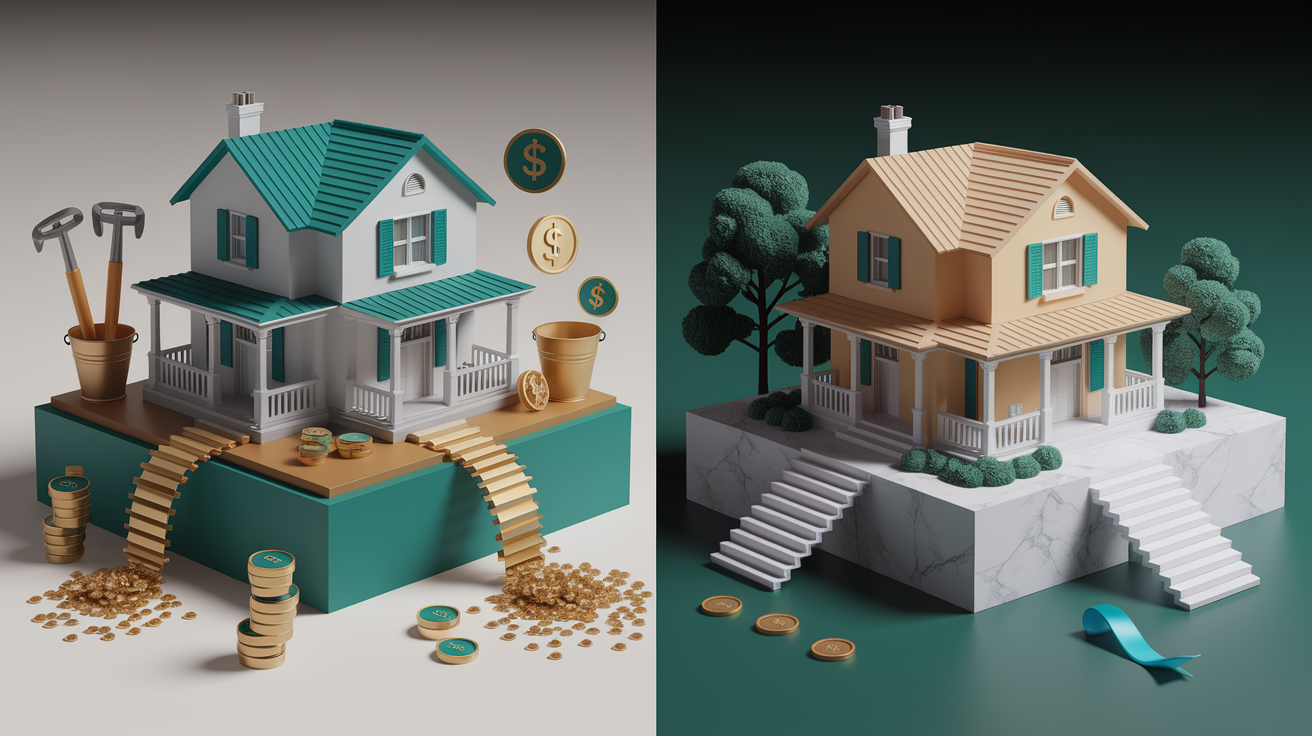
First example: You bought a rental property for $200,000. Over five years, you claimed $30,000 in depreciation. You spent $20,000 on capital improvements (new roof and HVAC). You sell for $350,000 and pay $21,000 in selling costs (6% commission).
Adjusted basis = $200,000 (purchase) + $20,000 (improvements) minus $30,000 (depreciation) = $190,000. Amount realized = $350,000 (sale price) minus $21,000 (selling costs) = $329,000. Total capital gain = $329,000 minus $190,000 = $139,000. Depreciation recapture = $30,000 taxed at 25% = $7,500. Remaining long-term gain = $109,000 taxed at 15% = $16,350. Total federal tax = $23,850 before NIIT or state tax.
Second example: You inherited a rental property valued at $300,000 at your parent’s death (step-up in basis). You sell it two years later for $310,000 and pay $18,600 in selling costs.
Adjusted basis = $300,000 (stepped-up fair market value at death). No depreciation recapture because you didn’t claim depreciation during the holding period. Amount realized = $310,000 minus $18,600 = $291,400. Capital gain = $291,400 minus $300,000 = negative $8,600 (a loss). No tax owed. You can use the $8,600 loss to offset other capital gains or up to $3,000 of ordinary income.
Using a 1031 Exchange to Defer Taxes
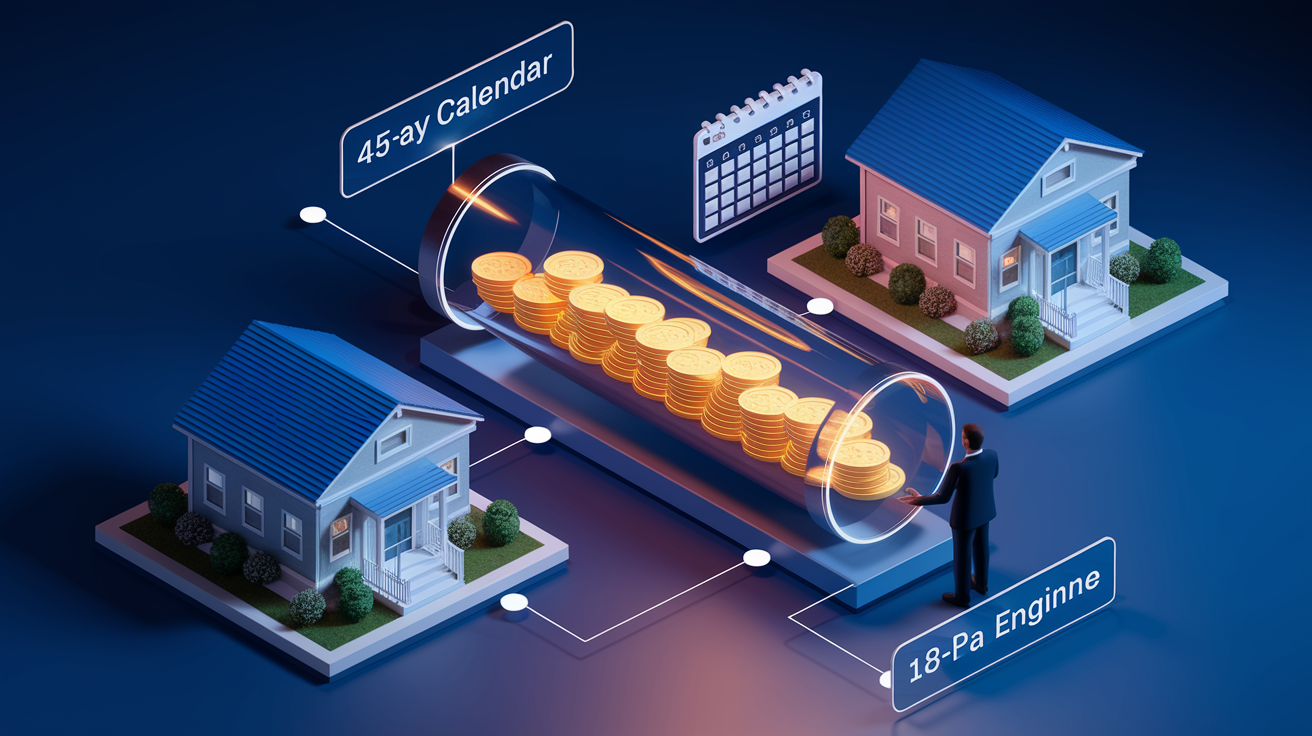
A 1031 like-kind exchange lets you defer both capital gains and depreciation recapture by reinvesting your sale proceeds into another qualifying investment property. The deferral can last indefinitely if you keep exchanging into new properties. The tax bill comes due only when you sell without reinvesting. The replacement property must be similar in nature (real property for real property) and equal or greater in value. Any cash or debt relief you take out (called “boot”) becomes immediately taxable.
Timing is strict and non-negotiable. You have 45 calendar days from the sale date to identify replacement properties in writing to your qualified intermediary. You must close on the replacement property within 180 days of the original sale, or by your tax return due date (including extensions) if that comes first. Miss either deadline and the entire gain becomes taxable in the year of sale.
Key 1031 exchange requirements:
Use a qualified intermediary to hold the proceeds. You can’t touch the money between sales. Identify up to three potential replacement properties in writing within 45 days. Close on the replacement property within 180 days. Replacement property must be equal or greater in value, and you must reinvest all equity to defer 100% of the gain.
When a Rental Property Qualifies for the Primary Residence Exclusion

Section 121 of the tax code lets you exclude up to $250,000 of gain ($500,000 if married filing jointly) when you sell your primary residence, as long as you meet the ownership and use tests. You must have owned the home for at least two years and lived in it as your main home for at least two of the five years before the sale. The two years don’t need to be consecutive. If you convert a rental property into your primary residence and meet the test, you can claim a partial or full exclusion. But depreciation taken after May 6, 1997, is never excludable and must still be recaptured at up to 25%.
Non-qualified use periods (time the property was not your primary residence) reduce your exclusion proportionally. For example, if you rented a property for three years, then lived in it for two years before selling, three-fifths of your gain is attributed to non-qualified use and won’t be excluded. Only the gain allocated to the two years you lived there qualifies for the exclusion. Depreciation recapture still applies to the entire period the property was rental, even during the years it qualifies as your primary residence.
How non-qualified use affects your exclusion:
Non-qualified use includes any period after 2008 when the property was not your primary residence. The exclusion is prorated: (non-qualified use years divided by total years owned) times gain equals non-excludable gain. Depreciation claimed during rental periods is always recaptured and taxed up to 25%, regardless of the residence exclusion.
State-Level Differences in Capital Gains Tax

State tax treatment of capital gains varies widely and can add thousands to your final bill. Some states have no income tax at all, meaning zero state capital gains tax. Others tax capital gains as ordinary income at rates that can exceed 13%. A few states offer preferential capital gains rates or partial exclusions, but most follow federal classification. If it’s a long-term gain federally, it’s treated the same at the state level. Depreciation recapture is usually taxed as ordinary income at the state level, just like federal treatment.
State examples and their general approach:
Texas and Florida: no state income tax, 0% state capital gains tax. California: taxes capital gains as ordinary income, top rate 13.3%. New York: taxes capital gains as ordinary income, top rate around 10.9% (varies by locality). Pennsylvania: flat 3.07% tax on all income, including capital gains. Washington: no state income tax on individuals, 7% tax on capital gains above $250,000 (recent law, verify current status).
Strategies to Reduce Taxes on Rental Property Sales

Timing and planning can save you more than any single deduction. Hold the property longer than one year to access long-term capital gains rates instead of paying ordinary income rates on a short-term flip. Document every capital improvement with receipts and invoices (new flooring, plumbing upgrades, roof replacements) because those costs increase your basis and lower your taxable gain dollar-for-dollar.
Six ways to lower your tax bill:
Hold the property for more than one year to qualify for long-term capital gains rates (0%, 15%, or 20% instead of up to 37%). Increase your adjusted basis by tracking and documenting every capital improvement. Save receipts, permits, and contractor invoices. Harvest capital losses from other investments in the same tax year to offset your rental property gain. Up to $3,000 of net losses can offset ordinary income annually. Convert the rental to your primary residence and live in it for two of the last five years to qualify for the Section 121 exclusion (up to $250,000 or $500,000 excluded). Use a 1031 exchange to defer the entire gain by reinvesting proceeds into another qualifying investment property within the 45 and 180-day windows. Time the sale in a year when your other income is lower to stay in a lower capital gains bracket and avoid or reduce the 3.8% NIIT.
When to Seek Professional Tax Help

Complex rental property sales almost always benefit from professional guidance. A CPA or tax attorney can model multiple scenarios, ensure you’re using the correct adjusted basis, handle multi-state filing requirements, and structure the sale to minimize tax. If your situation involves large depreciation schedules, multiple properties, or a 1031 exchange, mistakes can cost tens of thousands of dollars or trigger IRS scrutiny.
When to call a tax professional:
You’re planning a 1031 exchange and need to coordinate timing, intermediaries, and replacement property identification. The property spans multiple states or you’re subject to multiple state tax jurisdictions. You’ve claimed bonus depreciation or cost segregation and need to calculate the recapture correctly. You’re converting a rental to a primary residence or selling a property with mixed personal and rental use periods.
Final Words
Crunch the core facts now: how taxes apply when you sell, how to calculate gains, and how depreciation recapture raises your tax bill.
You also learned rate differences, real examples, 1031 timing, the primary-residence rule, and how states vary — plus practical ways to reduce what you owe.
Before you sell, gather your numbers, run the step-by-step calc, and if it’s a big sale, get a pro. With a clear checklist you’ll handle the capital gains tax on sale of rental property more confidently and keep more of your proceeds.
FAQ
Q: How much will I pay in capital gains when I sell my rental property?
A: The amount you’ll pay in capital gains when you sell your rental property depends on your taxable gain (sale price minus selling costs minus adjusted basis). Expect long‑term rates (0/15/20%), depreciation recapture up to 25%, NIIT.
Q: What is the 20% rule for capital gains?
A: The 20% rule refers to the top federal long‑term capital gains rate: high‑income taxpayers pay 20% on long‑term gains above income thresholds; depreciation recapture is taxed separately (up to 25%).
Q: How much capital gains tax will I pay on $200,000?
A: If you have a $200,000 capital gain, federal tax is commonly 15% or 20% depending on income; add 3.8% NIIT if applicable, and up to 25% on any depreciation recapture; state tax may apply.
Q: What is the 6 year rule on capital gains tax?
A: The “6 year rule” on capital gains is not a single federal rule; six‑year periods sometimes matter under certain state rules or specific look‑backs after conversions. Confirm dates and use history with your CPA.

