

What if a losing trade could save you thousands in taxes?
Tax-loss harvesting does exactly that: you sell investments at a loss in a taxable account to offset gains, cut your current-year tax bill, and even deduct up to $3,000 against ordinary income.
This post shows how it works in practice.
You’ll get a simple, step-by-step process for choosing lots, avoiding the IRS wash-sale rule, timing trades before year-end, and tracking carryforwards.
By the end you’ll know what to do next and what numbers to bring to your CPA.
Understanding How Tax Loss Harvesting Works in Practice

Tax loss harvasting means selling investments in a taxable brokerage account at a loss so you can generate realized capital losses that cut your current-year tax bill. It works because the IRS lets you use realized losses to offset realized capital gains, which reduces or wipes out the taxes you’d otherwise owe on profitable trades. If your total realized losses beat your realized gains for the year, you can also deduct up to $3,000 of the net loss against ordinary income ($1,500 if married filing separately). Anything left over carries forward indefinitely to future tax years.
Realized losses are what actually count here. These happen when you sell an investment that’s declined below what you paid for it. Unrealized losses, those paper losses you see in your account when something’s down but you haven’t sold, don’t create any tax benefit. You have to execute the sale and settle the transaction to realize the loss and make it available to offset gains or ordinary income. The IRS nets all your realized losses against all your realized gains within the same tax year, and the resulting net loss or gain determines your tax outcome.
Here’s what tax loss harvesting accomplishes:
- Realize a capital loss by selling a taxable-account holding that’s declined below your cost basis.
- Offset realized capital gains from other sales during the same tax year (short-term losses offset short-term gains first, then long-term losses offset long-term gains first).
- Offset up to $3,000 of ordinary income in the current year if net losses exceed net gains.
- Carry forward unused losses to future years without expiration, applying the same offset rules each year until you’ve used them all.
Say you realize a $10,000 long-term capital loss by selling a losing stock position. If you also have a $10,000 long-term capital gain from selling a winner, the loss offsets the gain completely. You owe zero tax on that $10,000 gain. At a 15% long-term capital gains tax rate, you just saved $1,500 in federal taxes. If instead you have no gains and use that $10,000 loss against ordinary income, the IRS lets you deduct $3,000 this year. At a 24% marginal tax bracket, that $3,000 deduction saves $720 in tax, and the remaining $7,000 loss carries forward to next year. Tax loss harvesting turns portfolio setbacks into real tax savings.
Step-by-Step Process for Executing Tax Loss Harvesting Transactions

Correct lot identification and accurate cost-basis documentation are the foundation of successful tax loss harvesting. Every time you buy shares, you create a separate tax lot with its own purchase date, share count, and cost basis. When you sell, you must identify which specific lot or lots you’re selling to determine the realized gain or loss. Most brokers default to “first in, first out” (FIFO), but many let you choose specific lots (specific identification), which gives you control over whether you realize a gain or a loss and whether it’s short-term or long-term. Keep detailed records of every purchase and sale, including trade confirmations, settlement dates, and the reasoning behind lot selections.
Choosing a replacement security preserves your market exposure while avoiding the wash-sale rule. After you sell a losing position, you typically want to stay invested in a similar asset class or sector without triggering a disallowed loss. The replacement should track a similar index, sector, or investment thesis but can’t be “substantially identical” to what you sold. For example, if you sell a U.S. large-cap growth ETF from one provider, you might immediately buy a U.S. large-cap growth ETF from a different provider with slightly different holdings or methodology. This keeps you exposed to the same market segment while the IRS treats the two securities as distinct.
Here’s how to execute a tax loss harvesting transaction correctly:
- Review your taxable brokerage account holdings and identify positions with unrealized losses that no longer fit your allocation or that you’re willing to replace with similar substitutes.
- Select the specific tax lots to sell using your broker’s lot-selection tools, choosing lots that will produce the desired realized loss and match your short-term or long-term tax goals.
- Execute the sale before the calendar year ends (settlement must occur by December 31 to count for that tax year), and immediately document the trade confirmation, sale date, proceeds, cost basis, and realized loss amount.
- Reinvest the proceeds into a replacement security on the same day or shortly after to maintain market exposure, making sure the replacement isn’t substantially identical to what you sold.
- Wait at least 31 calendar days before repurchasing the original security if you prefer to own it again, or simply hold the replacement permanently if it meets your allocation needs.
- Track the replacement’s holding period separately because the new purchase starts a fresh holding-period clock, and maintain records of the original cost basis, the harvested loss, and any carryforward amounts for future tax returns.
IRS Wash-Sale Rule and Timing Constraints for Loss Harvesting

The wash-sale rule disallows a capital loss if you buy the same or a “substantially identical” security within 30 calendar days before or after the sale that generated the loss. This creates a 61-day window centered on the sale date: 30 days before the sale, the sale date itself, and 30 days after the sale. If you purchase the same security anywhere within that window, the IRS will disallow the loss on your tax return and instead add the disallowed loss amount to the cost basis of the replacement shares you bought. The adjusted basis defers the loss until you eventually sell the replacement, but you lose the immediate tax benefit you were trying to harvest. To avoid a wash sale, wait at least 31 days after the sale before repurchasing the identical security, or buy a different security that’s similar but not substantially identical.
The wash-sale rule applies across all your taxable brokerage accounts, your spouse’s accounts, and even your IRA or 401(k) if you (or your spouse) buy the same security in a retirement account within the 30-day window. Many investors accidentally trigger wash sales by selling a stock in their taxable account and then buying the same stock inside their IRA a few days later. When this happens, the loss is permanently disallowed because you can’t adjust the cost basis of an IRA holding. The IRS also applies the rule to securities bought by entities you control, so selling in your individual account and repurchasing in a joint account or a trust can create the same problem. Track all your accounts and your spouse’s accounts to make sure no identical purchases occur within the forbidden window.
When a wash sale gets triggered, the disallowed loss doesn’t disappear. It gets added to the cost basis of the replacement shares, which defers the tax benefit until you sell the replacement in a non-wash-sale transaction. Say you sell 100 shares at a $1,000 loss and immediately rebuy the same 100 shares. The $1,000 loss is disallowed and your cost basis in the new shares increases by $1,000. You’ll eventually recognize that loss when you sell the new shares, as long as you don’t trigger another wash sale. To capture the immediate tax benefit, use a practical avoidance strategy: either wait a full 31 days before repurchasing the original security, or immediately buy a non-identical substitute that tracks a similar index or sector but has different holdings, a different issuer, or a different methodology.
Tax Mechanics: Short-Term vs Long-Term Loss Netting and Carryforward Rules

The IRS requires you to net capital gains and losses using a specific ordering sequence that separates short-term and long-term transactions. Short-term capital losses (from assets held one year or less) must first be applied to offset short-term capital gains, which are taxed at ordinary income tax rates. Long-term capital losses (from assets held more than one year) must first offset long-term capital gains, which are taxed at preferential rates of 0%, 15%, or 20% depending on your taxable income. Only after you’ve netted within each category do you apply any remaining net loss from one category to offset net gains in the other category. This ordering determines the character of your final net gain or loss and directly affects how much tax you save.
If your total capital losses exceed your total capital gains for the year, you can deduct up to $3,000 of the net capital loss against your ordinary income ($1,500 if you file married filing separately). Any net capital loss beyond that $3,000 annual limit carries forward indefinitely to future tax years, where it retains its short-term or long-term character and follows the same netting rules. There’s no expiration on capital loss carryforwards. You can use them year after year until the entire amount is exhausted. Keep careful records of carryforward amounts each year, because the IRS expects you to apply them correctly against future gains and ordinary income.
| Loss Type | Offset Ordering | Tax Impact |
|---|---|---|
| Short-term capital loss | First offsets short-term capital gains (taxed at ordinary rates); excess can offset long-term gains or up to $3,000 ordinary income; remainder carries forward as short-term loss | Saves tax at ordinary income rates when offsetting short-term gains or ordinary income (10% to 37% federal); saves at preferential rates (0% to 20%) when offsetting long-term gains |
| Long-term capital loss | First offsets long-term capital gains (taxed at 0%/15%/20%); excess can offset short-term gains or up to $3,000 ordinary income; remainder carries forward as long-term loss | Saves tax at preferential long-term rates when offsetting long-term gains; saves at ordinary rates when offsetting short-term gains or ordinary income |
| Net capital loss (after all netting) | Deduct up to $3,000 ($1,500 MFS) against ordinary income in current year; carry forward any excess to future years | Current-year deduction saves tax at your marginal ordinary rate; carryforward preserves future offset capability |
Real-World Tax Loss Harvesting Scenarios and Calculations

Numeric examples make the tax mechanics of harvesting concrete and show exactly how much money you can save. Walking through realistic scenarios with actual dollar amounts, tax rates, and offset rules helps you evaluate whether harvesting is worth the effort and transaction costs in your situation. The examples below use common tax brackets and standard long-term capital gains rates to illustrate both the immediate tax benefit and the carryforward effect when losses exceed the annual deduction limit.
| Scenario | Loss Amount | Tax Rate | Tax Savings |
|---|---|---|---|
| Offset $20,000 short-term gain with $25,000 short-term loss (35% marginal rate) | $25,000 short-term loss | 35% (ordinary income) for gain offset; 35% for $3,000 ordinary-income deduction | $20,000 gain offset saves $7,000; $3,000 ordinary-income offset saves $1,050; total immediate savings = $8,050; $2,000 loss carries forward |
| Use $3,000 net loss to offset ordinary income (30% marginal rate, no gains) | $3,000 net capital loss | 30% (ordinary income) | $3,000 × 30% = $900 immediate tax savings |
Key observations from these scenarios:
Carryforward effect: In the first scenario, the $25,000 loss offsets all $20,000 of short-term gains and uses $3,000 against ordinary income, producing $8,050 in total tax savings this year. The remaining $2,000 loss carries forward to next year, where it can offset future gains or another $2,000 of ordinary income (subject to the $3,000 annual limit).
Ordinary-income offset limits: You can only deduct $3,000 of net capital losses against ordinary income per tax year ($1,500 if married filing separately), no matter how large your total net loss. This cap means a $10,000 net loss would take multiple years to fully utilize if you have no capital gains to offset.
Short-term vs long-term offset differences: Short-term gains are taxed at ordinary rates (10% to 37% federal), so harvesting short-term losses to offset short-term gains saves tax at those higher rates. Long-term gains are taxed at 0%, 15%, or 20%, so harvesting long-term losses to offset long-term gains saves less per dollar, but the strategy still reduces your tax bill and preserves cash.
Compounding benefit of reinvested tax savings: The second scenario shows an immediate $900 tax savings from a $3,000 loss at a 30% rate. If you reinvest that $900 in your portfolio and it compounds at 6% annually for 20 years, the future value is approximately $2,885. That turns a short-term tax benefit into long-term wealth accumulation.
These examples show that tax loss harvesting delivers real, measurable savings, especially when you can offset high-rate short-term gains or use losses year after year through carryforwards. The key is to run the numbers for your specific tax situation and compare the benefit against any transaction costs or risks.
Timing Strategies for Effective Tax Loss Harvesting Throughout the Year

Opportunistic harvesting during market dips captures losses when individual stocks, sectors, or the entire market decline sharply. Volatility creates temporary price drops in positions you want to hold long-term, giving you a window to sell at a loss, immediately replace with a similar non-identical security, and book the tax benefit without leaving the market. Many investors set alerts or review their taxable accounts after big down days to identify freshly available losses. This approach requires active monitoring but can harvest larger losses in a single trade compared to systematic strategies.
Systematic and rebalancing-driven harvesting integrates tax loss harvesting into your regular portfolio maintenance. Robo-advisors and some wealth managers run daily or weekly checks across all holdings, automatically selling positions with losses above a minimum threshold (say, $100 or $500) and reinvesting into pre-approved replacement securities. This continuous process captures many small losses year-round that might otherwise be missed. Manual investors can adopt a similar discipline by reviewing taxable accounts monthly or quarterly and harvesting any position that’s drifted below its target allocation and shows a loss. Rebalancing naturally generates opportunities to harvest because underperforming asset classes tend to fall below target weight and often carry unrealized losses.
Year-end deadlines create urgency and risk if you delay too long. To count a realized loss for the current tax year, the sale must settle by December 31. Most stock and ETF trades settle two business days after the trade date (T+2), so you must place your order by the last trading day that allows settlement before year-end (typically December 29 or 30, depending on weekends and holidays). If you wait until December 31 to sell, the trade will settle in January and the loss will apply to the following tax year, missing the current year’s offset opportunity. Many investors conduct a final harvesting sweep in early to mid-December to lock in losses and avoid last-minute settlement problems or market gaps.
Factors that influence when you should harvest:
Market volatility and sector rotation: Sudden declines in specific sectors or asset classes create fresh losses; harvest opportunistically when positions fall below cost basis and you’re willing to replace them.
Expected tax bracket changes: If you expect to be in a higher marginal bracket next year (due to a promotion, bonus, RSU vesting, or other income), consider delaying harvesting until you can use the loss at the higher rate. Conversely, harvest now if you expect lower income next year.
Realized gains already booked during the year: If you’ve sold winners earlier in the year and have taxable gains to offset, prioritize harvesting before December 31 to reduce or wipe out the tax bill on those gains. If you have no gains, the ordinary-income offset ($3,000 limit) may be less urgent and you can wait for better opportunities.
Replacement Assets and Maintaining Market Exposure After Tax Loss Harvesting

Investors use replacement securities to stay invested in the market immediately after a tax loss harvesting sale, avoiding the risk of missing a recovery while waiting out the 30-day wash-sale window. Selling a losing position removes your exposure to that specific stock, ETF, or fund, but buying a similar (yet not substantially identical) replacement on the same day keeps you invested in the same sector, asset class, or market segment. This approach maintains your portfolio’s risk profile and strategic allocation while still capturing the tax benefit of the realized loss.
Acceptable replacement substitutes that preserve market exposure without triggering wash sales:
Similar-index ETFs from different issuers: Sell a large-cap U.S. equity ETF from Provider A and immediately buy a large-cap U.S. equity ETF from Provider B that tracks a similar but distinct index with slightly different methodology or constituent stocks.
Factor-tilted or style-rotated funds: Replace a broad market fund with a value-tilted, growth-focused, or dividend-weighted fund in the same asset class, providing similar but non-identical exposure.
Sector or thematic funds: Temporarily shift from a diversified equity position into a sector fund (say, technology or healthcare) that overlaps with your original holding’s largest positions, then rotate back after 31 days.
Non-identical international or bond ETFs: Replace a developed-markets international equity fund with a similar fund that has different country weightings or currency hedging, or swap one aggregate bond fund for another with a slightly different duration or credit profile.
Diversified mutual funds or active strategies: Substitute an index ETF with an actively managed mutual fund targeting the same investment objective, since active funds typically have different holdings and aren’t considered substantially identical to passive index trackers.
Correlation-aware substitution maintains your intended risk exposures while respecting the wash-sale rule. The replacement doesn’t need to be a perfect clone of the original security. It just needs to provide similar market exposure so your overall portfolio risk and expected return stay close to your target allocation. Check the correlation between the original and replacement over trailing periods (say, 1-year or 3-year rolling correlation) to make sure they move together closely, ideally above 0.90 or 0.95. High correlation means the replacement will capture most of the same market moves, reducing tracking error and keeping your strategic asset mix intact. After 31 days, you can sell the replacement and repurchase the original security if you prefer, or simply hold the replacement permanently if it meets your goals and keeps costs low.
Using Automated Tools and Robo-Advisors for Tax Loss Harvesting

Automation works by continuously monitoring every tax lot in your taxable account and executing harvesting trades whenever a position falls below its cost basis by a pre-set threshold. Robo-advisors and some wealth-management platforms run these checks daily, comparing the current price of each lot to its purchase price and automatically selling any lot with a loss above the minimum (commonly $100, $250, or $500). The system immediately reinvests proceeds into a pre-approved replacement security from a list of non-identical alternatives, making sure you stay invested while capturing the loss. Frequent, small harvests compound over time, often generating total annual tax savings that exceed what manual investors capture in quarterly or year-end reviews. Some platforms also coordinate harvesting across multiple accounts (taxable, joint, trust) to maximize total household tax benefit.
Cost considerations and limitations vary by platform and service level. Entry-level robo-advisors typically charge annual advisory fees ranging from 0.25% to 0.50% of assets under management, which covers automated tax loss harvesting, rebalancing, and basic financial planning tools. Some platforms require minimum account balances (say, $5,000, $10,000, or $50,000) to access tax loss harvesting features, and a few offer the service only at higher fee tiers or for larger portfolios. The advisory fee reduces your net returns, so compare the fee against the expected annual tax benefit to make sure automation is cost-effective. Automated systems also limit customization. You can’t choose specific replacement securities, control the exact timing of each trade, or integrate wash-sale avoidance across external accounts the platform doesn’t manage. If you hold the same or similar securities in other taxable accounts, IRAs, or with other custodians, the robo-advisor can’t see those positions and may inadvertently create wash sales.
Automation is a good fit when you want hands-off, continuous harvesting without the time and complexity of manual lot tracking, and when your taxable account is large enough that frequent small harvests add up to meaningful tax savings that exceed the advisory fee. It works especially well for busy investors in high tax brackets who realize frequent gains from rebalancing or capital distributions and benefit from year-round offset opportunities. DIY harvesting is preferred when you have a smaller taxable account where advisory fees would consume most of the tax benefit, when you want full control over security selection and timing to align with your personal tax planning, or when you hold similar positions across multiple accounts and need to coordinate wash-sale avoidance manually. Many investors use a hybrid approach, automating harvesting in one large taxable account through a robo-advisor while manually managing other accounts to prevent cross-account wash sales.
Reporting Requirements for Tax Loss Harvesting on IRS Forms
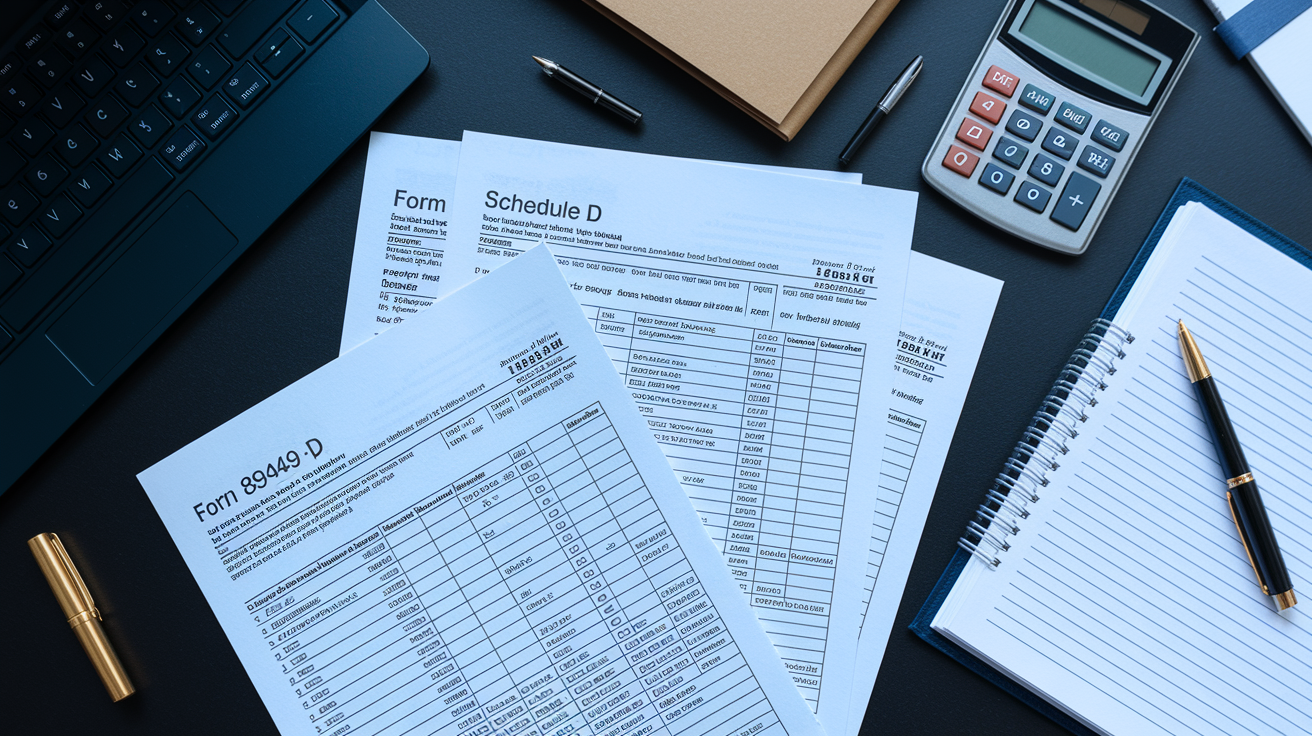
Form 8949 requires you to list every capital-asset sale during the tax year, including the description of the property sold, the date you acquired it, the date you sold it, the proceeds from the sale, your cost basis, and the resulting gain or loss. Each realized loss from tax loss harvesting must appear on Form 8949 with complete detail so the IRS can verify your calculations. You’ll report short-term transactions (assets held one year or less) in Part I and long-term transactions (assets held more than one year) in Part II. If a wash sale occurred, you must adjust the reported loss to zero on Form 8949 and indicate the wash-sale adjustment in the appropriate column, then add the disallowed loss to the cost basis of the replacement shares. Your brokerage will typically provide a year-end Form 1099-B that lists all your sales, but you’re responsible for making sure the cost basis is correct and for identifying and adjusting any wash sales the broker may have missed.
Key documents to keep for accurate reporting and future audits:
Trade confirmations for every sale and every replacement purchase, showing trade date, settlement date, number of shares, price, and total proceeds or cost.
Cost-basis records for each tax lot you sold, including the original purchase date, purchase price, any adjustments from prior wash sales or corporate actions, and the method used to identify which lots were sold (FIFO, specific identification, average cost).
Replacement purchase dates and details proving you bought a non-identical security or waited at least 31 days before repurchasing the original, documented with trade confirmations and notes explaining why the replacement isn’t substantially identical.
Wash-sale tracking notes for any transaction where you sold at a loss and bought a similar security within the 61-day window, including the amount of disallowed loss, the adjusted basis of the replacement, and the lot number or account where the replacement was purchased.
Schedule D summarizes the totals from Form 8949, combining all short-term and long-term gains and losses into net figures that determine your final capital gain or loss for the year. If you have a net capital loss, Schedule D calculates how much you can deduct against ordinary income (up to $3,000 or $1,500 MFS) and how much carries forward to next year. The carryforward amount is reported on the Capital Loss Carryover Worksheet in the Schedule D instructions, and you must track this number yourself year over year because it will reduce future gains or provide future ordinary-income deductions until fully used. Keep a running schedule of your capital loss carryforwards in your personal tax files, noting the year the loss was originally realized, the character (short-term or long-term), and how much has been used in each subsequent year.
Avoiding Common Mistakes in Tax Loss Harvesting Execution

Common pitfalls in tax loss harvesting can cost you the entire tax benefit or create unexpected consequences that outweigh the savings. The most frequent errors involve timing mistakes, wash-sale violations, cost miscalculations, and strategic misalignments with your broader investment plan. Understanding these mistakes before you execute your first harvest helps you build a reliable, repeatable process that maximizes tax savings without introducing new risks or headaches.
Four high-impact mistakes to avoid:
Missing the December 31 settlement deadline: Placing a sell order on the last trading day of the year often results in settlement in January, moving the loss to the next tax year and losing the current-year offset opportunity. Always execute year-end harvesting by mid-to-late December to make sure trades settle before year-end.
Triggering wash sales by repurchasing the same or substantially identical security within 30 days: Buying back the original stock, ETF, or mutual fund (or a nearly identical one) before the 30-day window closes disallows the loss and defers the tax benefit, often permanently if the repurchase occurred in an IRA. Track all your accounts and your spouse’s accounts to prevent accidental repurchases.
Ignoring bid-ask spread, commission, and market-impact costs: Small transaction fees, wide bid-ask spreads on illiquid securities, and slippage from selling or buying at unfavorable prices can reduce or wipe out the net tax benefit, especially when harvesting losses under $500. Always compare the after-tax savings to the round-trip trading cost before executing.
Harvesting losses that force you out of your target asset allocation or strategic positions: Selling a core holding to capture a loss and replacing it with a poorly correlated substitute can increase tracking error, change your risk exposure, and lead to underperformance that costs more than the tax savings. Only harvest when you can maintain similar exposure or when the position no longer fits your investment thesis.
Cost and behavioral dangers compound when investors chase tax savings without considering portfolio impact or market timing. Panic-selling quality long-term holdings during temporary downturns just to book a loss can lock in poor entry points for replacement securities and disrupt compounding. Trading costs add up quickly if you harvest frequently in small accounts or use high-fee funds. Behavioral biases lead some investors to over-harvest, creating unnecessary turnover and complexity in an attempt to maximize every possible deduction. The goal is disciplined, selective harvesting that balances tax efficiency with investment quality and cost control.
Documentation and planning are essential to avoid errors and defend your tax positions during an audit. Maintain a tax loss harvesting log that records every sale, the realized loss amount, the replacement security purchased (if any), the dates of both transactions, and a brief note explaining why the replacement isn’t substantially identical. Update your cost-basis tracking spreadsheet or software after every trade, adjusting for any wash-sale disallowances and carryforward balances. Before executing any harvest, verify that you won’t repurchase the same security in any account (taxable, IRA, spouse’s account) within the 61-day wash-sale window, and set calendar reminders if you plan to buy back the original security after 31 days. Plan year-end harvesting in early December, leaving time to review all accounts, coordinate with your spouse or tax advisor, and execute trades well before settlement deadlines.
Final Words
You learned how to turn losing positions into tax relief by realizing losses and matching them against gains.
We walked through the step-by-step trade process, the wash-sale 30-day rule, timing and replacement options, automation pros and cons, and the filing basics for Form 8949 and Schedule D.
Before you sell, pull your trade history, tag tax lots, avoid wash-sale traps, and check replacement choices with your CPA.
With a simple routine, tax loss harvesting can lower your bill and keep you invested. You’re on the right track.
FAQ
Q: Is tax-loss harvesting even worth it?
A: Tax-loss harvesting is worth it when it meaningfully lowers your tax bill or improves after-tax returns; benefits must exceed trading costs, wash-sale risks, and portfolio disruption. Ask your CPA if unsure.
Q: What qualifies for tax-loss harvesting?
A: Tax-loss harvesting applies to realized losses from selling taxable-account assets—like stocks, ETFs, crypto, and certain securities. Unrealized losses don’t qualify, and sales inside retirement accounts generally don’t count.
Q: What is the $3000 loss rule?
A: The $3,000 loss rule lets you deduct up to $3,000 of net capital losses against ordinary income each year ($1,500 if married filing separately); unused losses carry forward indefinitely.
Q: How much can you tax-loss harvest in a year?
A: You can realize unlimited capital losses in a year, but they first offset gains, then up to $3,000 of ordinary income; any remaining losses carry forward to future tax years.

