

Think short-term stock tax is just a tiny fee?
It can eat a big chunk of your gain once ordinary rates, NIIT, and state tax are stacked together.
This post explains how short-term stock tax works, what drives your bill, and a clear, step-by-step way to calculate what you’ll owe.
You’ll see simple examples you can reuse, quick checks to avoid costly timing mistakes, and the key times to talk to your CPA.
Understanding How Short-Term Stock Tax Works

A short-term stock tax applies when you sell shares or other capital assets you’ve held for one year or less. The holding period starts the day after you buy the asset and ends on the day you sell it. Buy stock on March 10 and sell it on March 9 the following year? You’ve held it for exactly 364 days. Still short-term. Sell on March 11 or later, and the gain becomes long-term.
Short-term capital gains are taxed at your ordinary federal income tax rates. That means they face the same brackets as your wages, bonuses, and freelance income. Those rates currently range from 10% to 37% depending on your total taxable income. If you earn enough to owe Net Investment Income Tax (NIIT), you’ll pay an additional 3.8% on top of the ordinary rate.
So if you realize a $10,000 short-term gain and fall into the 24% bracket, your federal tax bill on that gain is $2,400. Add NIIT and state tax, and the combined burden climbs quickly.
Here’s what drives your short-term stock tax liability:
Ordinary federal tax rates: 10%, 12%, 22%, 24%, 32%, 35%, or 37%
Net Investment Income Tax: additional 3.8% when modified adjusted gross income exceeds $200,000 (single) or $250,000 (married filing jointly)
State income tax: varies by state. Some have no income tax, others charge over 10%
Holding period: measured in calendar days from the day after purchase through the sale date
Cost basis: purchase price plus commissions and fees. Accurate basis is essential to calculate the taxable gain
A high earner example makes the impact clear. A $50,000 short-term gain taxed at 35% federal plus 3.8% NIIT equals $19,400 in federal tax alone. Throw in a 5% state rate, and the total tax hits $21,900. That’s nearly 44% of the gain.
How Short-Term Stock Tax Rates Compare to Long-Term Treatment

Long-term capital gains use three preferential federal tax brackets: 0%, 15%, and 20%. Special long-term rates of 25% apply to certain real estate depreciation recapture, and 28% applies to collectibles.
For 2025, if you’re single and your taxable income falls below $48,350, you pay 0% on long-term gains. The 15% rate covers income from $48,351 to $533,400, and the 20% rate kicks in above that. Married couples filing jointly get wider brackets: 0% up to $98,900, 15% up to $613,700, and 20% beyond.
Short-term gains, by contrast, are always taxed at ordinary rates. Potentially as high as 37% plus NIIT, regardless of your income level.
The table below highlights the key differences:
| Type | Rate Range | Holding Period |
|---|---|---|
| Short-Term Capital Gains | 10%–37% (ordinary income rates) | ≤1 year |
| Long-Term Capital Gains | 0%, 15%, 20% | >1 year |
| Special Long-Term | 25% (unrecaptured Sec.1250), 28% (collectibles) | >1 year |
Consider a $30,000 gain on stock purchased 11 months ago. If you’re in the 24% bracket and sell now, you owe $7,200 in federal tax on a short-term gain. Wait one more month and sell as a long-term gain, and the same $30,000 is taxed at 15%. Just $4,500.
Holding the position for 31 additional days saves you $2,700.
Calculating Short-Term Stock Tax Step-by-Step

Start with the sale proceeds you receive from your broker. Subtract your cost basis, what you originally paid for the shares plus any commissions or fees. The difference is your capital gain or loss.
If you bought 100 shares at $50 per share ($5,000 total) plus a $10 commission, your basis is $5,010. When you sell those shares for $7,000 minus a $10 commission (net $6,990), your gain is $6,990 − $5,010 = $1,980. That $1,980 gain is taxed at your ordinary rate if you held the shares for a year or less.
The IRS requires you to net all capital gains and losses before calculating what you owe. If you have a $1,000 short-term gain and a $200 short-term loss in the same year, you report a net $800 gain. Losses offset gains dollar for dollar.
If your losses exceed your gains, you can deduct up to $3,000 of the net loss against ordinary income each year (or $1,500 if married filing separately). Any remaining loss carries forward to future tax years.
Follow these steps to calculate your short-term stock tax:
- Gather all trade confirmations, showing purchase date, sale date, quantity, price, and fees.
- Calculate your cost basis: purchase price plus commissions and adjustments (reinvested dividends, corporate actions, etc.).
- Determine your sale proceeds: gross sale price minus broker fees or commissions.
- Subtract basis from proceeds to find your gain or loss for each position.
- Net all short-term gains and losses together.
- Apply your marginal federal tax rate to the net short-term gain, add NIIT if applicable, and include state tax if your state taxes capital gains.
| Factor | Impact on Taxable Gain |
|---|---|
| Purchase price + commissions | Increases cost basis; lowers gain |
| Sale proceeds − commissions | Lowers net proceeds; reduces gain |
Reporting Short-Term Stock Tax on IRS Forms
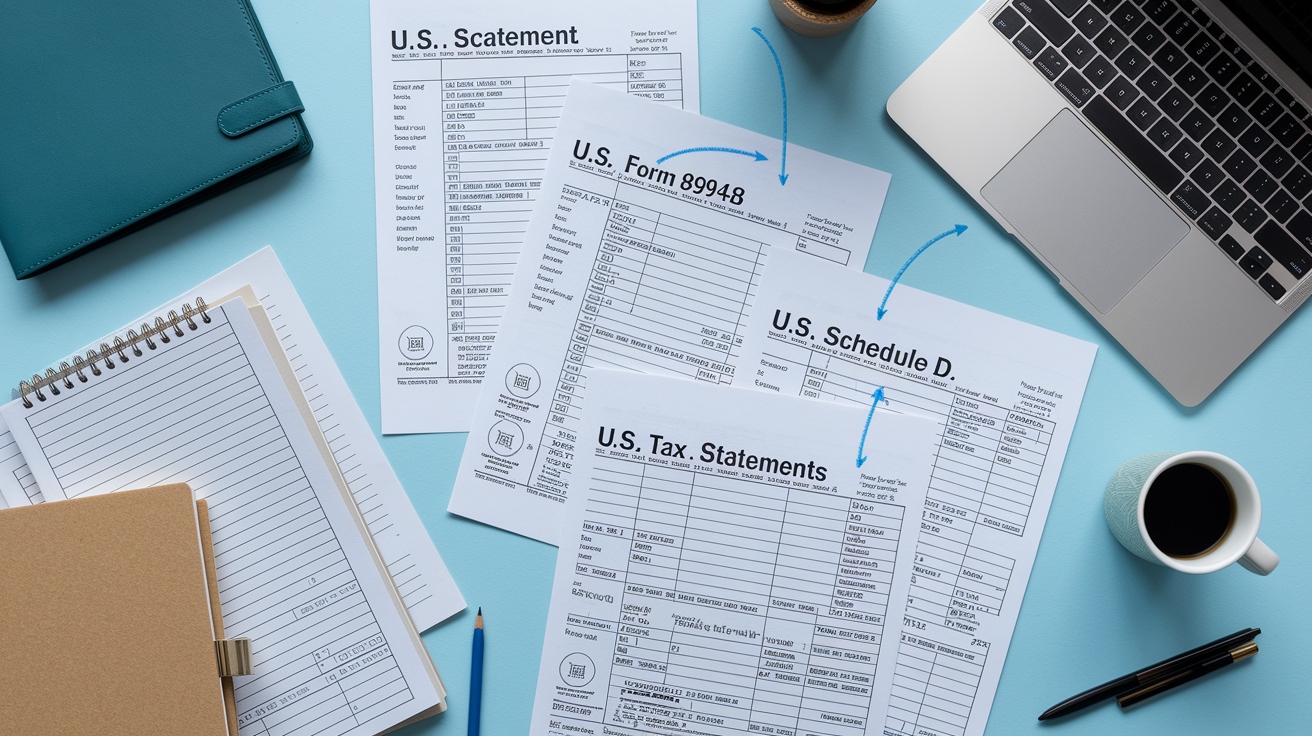
Your broker will send you Form 1099-B in mid-February, listing every sale during the tax year. The form shows gross proceeds in box 1d and cost basis in box 1e (for “covered” securities the broker tracks). Use those numbers to complete Form 8949, which is a line-by-line accounting of each transaction.
After you finish Form 8949, the totals flow to Schedule D, where you combine short-term and long-term results and calculate your overall capital gain or loss. Finally, the net figure moves to your Form 1040.
Keep trade confirmations, account statements, and any records of reinvested dividends or stock splits. These documents help you verify the 1099-B and make adjustments if the broker’s basis is wrong. Inherited shares, gifted stock, or shares acquired through employee compensation plans often require manual basis adjustments that won’t appear on a standard 1099-B.
Here are the key filing documents:
Form 1099-B: broker statement showing proceeds, basis, and dates for each sale
Form 8949: detailed sale-by-sale worksheet. Lists date acquired, date sold, proceeds, cost basis, and adjustments
Schedule D: summarizes short-term and long-term totals. Calculates net capital gain or loss
Form 1040: main tax return where final capital gain/loss appears on the income section
Trade confirmations and statements: backup documentation to resolve discrepancies or support adjustments during an audit
Short-Term Stock Tax and the Wash Sale Rule

A wash sale happens when you sell stock at a loss and then buy substantially identical shares within 30 days before or after the sale date. The IRS disallows the loss, which means you can’t use it to offset other gains or reduce taxable income in the year of sale. Instead, the disallowed loss is added to the cost basis of the replacement shares you purchased. That adjustment increases your basis and will reduce your gain (or increase your loss) when you eventually sell the replacement shares.
Timing is everything.
If you sell 100 shares of XYZ at a $500 loss on December 15 and buy 100 shares of XYZ again on December 20, the loss is disallowed because the repurchase occurred within the 30-day window. The $500 loss gets tacked onto the basis of the December 20 purchase.
Wash sales become tricky when you have multiple brokerage accounts, spouse accounts, or retirement accounts that hold the same stock. Buying in one account while selling in another can still trigger the rule.
Common wash-sale scenarios include:
Selling shares in a taxable brokerage account and repurchasing the same stock in an IRA or 401(k) within 30 days
Selling stock at a loss and buying call options on the same stock within the wash-sale window
Holding shares in multiple accounts (joint account, individual account, spouse account) and inadvertently repurchasing after a loss sale
Auto-reinvesting dividends that purchase new shares while you’re also harvesting losses in the same stock
Tax-Loss Harvesting to Reduce Short-Term Stock Tax

Tax-loss harvesting means selling depreciated positions to realize capital losses, which you can use to offset capital gains or up to $3,000 of ordinary income per year. If you have $10,000 in short-term gains and harvest $8,000 in short-term losses, your net taxable gain drops to $2,000. If you harvest an $8,000 loss but have no gains in the same year, you can deduct $3,000 against wages or other ordinary income, then carry forward the remaining $5,000 loss to future years.
The strategy works best at year-end when you know your total gains for the year and can fine-tune your loss harvesting. But remember the 30-day wash-sale rule. After you sell a loser, wait at least 31 days before repurchasing the same stock, or buy a similar (but not substantially identical) security to maintain market exposure while preserving the tax loss.
Losses carry forward indefinitely until you use them, so one large loss can offset gains for years.
| Scenario | Loss | Resulting Tax Impact |
|---|---|---|
| $10,000 gain + $8,000 loss harvested | $8,000 | Net gain = $2,000; tax on $2,000 only |
| No gains + $8,000 loss harvested | $8,000 | Deduct $3,000 from ordinary income; carry forward $5,000 |
| $5,000 gain + $7,000 loss harvested | $7,000 | Net loss = $2,000; deduct $2,000 from ordinary income |
State Taxes and Additional Surtaxes Affecting Short-Term Stock Tax

Nine states (including Alaska, Florida, Nevada, South Dakota, Tennessee, Texas, Washington for most income, and Wyoming) don’t impose a personal income tax on capital gains. New Hampshire taxes only dividends and interest, not capital gains. Missouri exempts capital gains despite having an income tax.
For residents of the remaining states, short-term gains are generally taxed as ordinary income at the state level, which can range from low single digits to over 13% in California.
High earners face the federal Net Investment Income Tax, a 3.8% surtax on net investment income when modified adjusted gross income exceeds $200,000 (single) or $250,000 (married filing jointly). Combined federal, NIIT, and state rates can exceed 50% in high-tax states.
For example, a California resident in the top federal bracket (37%) plus NIIT (3.8%) plus California’s top rate (~13.3%) pays a combined marginal rate of roughly 54% on short-term gains.
Notable state and surtax items:
NIIT threshold: 3.8% additional tax when MAGI exceeds $200,000 single / $250,000 married filing jointly
California: top state rate ~13.3%. Combined federal + NIIT + state can approach or exceed 54%
New York: top state rate ~10.9% (NYC residents add city tax)
Washington: long-term capital gains taxed at 7% (first $1 million) and 9.9% (above $1 million) starting 2025. No tax on short-term gains or on ordinary income
No-income-tax states: Alaska, Florida, Nevada, South Dakota, Tennessee (limited), Texas, Washington (for most income), Wyoming, New Hampshire (dividends/interest only)
Special Short-Term Stock Tax Rules for Active Traders

Active traders who meet IRS criteria for Trader Tax Status can elect to treat trading as a business, allowing deductions for home office, education, software, and data subscriptions as business expenses rather than miscellaneous itemized deductions. To qualify, you must trade frequently, hold positions for short periods, and seek profit from daily price movements rather than long-term appreciation.
The IRS looks at facts and circumstances. Occasional trading or buy-and-hold investing won’t qualify.
Options have their own quirks. Most stock options follow the same short or long-term holding rules as stocks, measured from the day after purchase of the option contract. Section 1256 contracts (certain regulated futures, broad-based index options, and foreign currency contracts) are taxed under a 60/40 rule: 60% of the gain or loss is treated as long-term and 40% as short-term, regardless of actual holding period. These contracts are also marked to market at year-end, meaning you recognize gains and losses on open positions as if you closed them on December 31.
Active traders often owe estimated taxes. If you expect to owe $1,000 or more when you file, the IRS requires quarterly estimated payments. Missing payments or underpaying can trigger penalties and interest. High-frequency traders also draw IRS scrutiny, so meticulous recordkeeping (trade date, time, quantity, price, and strategy) is essential.
Unique tax considerations for active traders:
Trader Tax Status (TTS): permits ordinary business deductions for trading expenses. Requires substantial, frequent, and regular trading activity
Mark-to-market election (Section 475(f)): allows traders to treat gains and losses as ordinary income/loss. Eliminates the $3,000 capital loss limit and wash-sale rule. Must elect by the prior year’s tax deadline
Section 1256 contracts: futures and certain index options taxed 60% long-term / 40% short-term, regardless of holding period
Estimated tax payments: required if expected tax due is $1,000 or more. Calculated and paid quarterly (April 15, June 15, September 15, January 15)
Options holding period: starts the day after purchase. Short-term if held ≤1 year
Wash-sale complexity: applies across all accounts and family members. Tracking can be burdensome for high-volume traders
Using Tax-Advantaged Accounts to Avoid Short-Term Stock Tax

Trades executed inside an IRA, 401(k), or other qualified retirement account don’t trigger capital gains tax in the year of the trade. You can buy and sell stocks, options, and ETFs as frequently as you want without owing short-term tax on each transaction.
In a traditional IRA or 401(k), you defer all taxation until you withdraw the money, and those withdrawals are taxed as ordinary income regardless of whether the original gains were short or long-term. Roth IRAs and Roth 401(k)s offer tax-free growth and tax-free qualified withdrawals, making them ideal for high-turnover strategies.
Active traders and day traders benefit most from holding short-term positions inside retirement accounts, where the frequent turnover won’t create an annual tax headache. Tax-efficient investors also use these accounts to rebalance portfolios or harvest gains and reinvest without immediate tax consequences.
Just remember contribution limits and early-withdrawal penalties. Pulling money out before age 59½ can trigger a 10% penalty plus ordinary income tax on traditional accounts.
Benefits of trading inside tax-advantaged accounts:
No capital gains tax on trades: buy and sell freely without triggering short-term or long-term tax in the transaction year
Tax deferral (traditional accounts): pay ordinary income tax only when you withdraw. Ideal for rollover and compounding
Tax-free growth (Roth accounts): qualified Roth withdrawals are entirely tax-free. Perfect for high-growth, high-turnover strategies
Simplified recordkeeping: no need to track cost basis and holding periods for capital gains reporting. The custodian handles year-end valuation
Things to Keep in Mind About Short-Term Stock Tax

Before you sell, check the holding period. Waiting a few extra days can shift a gain from short-term to long-term and cut your tax rate in half or more.
Keep digital or paper copies of trade confirmations, 1099-B forms, and account statements for at least three years after filing. Longer if you have carryforward losses or complex basis adjustments. Year-end is the last chance to harvest losses, so review your portfolio in November and December to offset realized gains.
Key reminders:
Timing matters: holding a stock 366 days instead of 364 can save thousands in taxes
Track your basis carefully: reinvested dividends, stock splits, and mergers all adjust basis. Mistakes inflate your tax bill
Use year-end for tax-loss harvesting: December sales can offset gains recognized earlier in the year
Watch the wash-sale window: wait 31 days after a loss sale before repurchasing to preserve the deduction
File estimated payments if required: avoid penalties by paying quarterly if you expect to owe $1,000 or more
Keep records beyond three years: carryforward losses and inherited shares often require documentation from prior years. Brokers only retain detailed records for a limited time
Final Words
You now know the essentials: gains held one year or less are taxed at ordinary rates, how to figure gain (sale minus basis), and the key forms and rules that can change your bill.
You also saw how short-term treatment compares to long-term rates, wash-sale and NIIT traps, and practical moves like tax-loss harvesting, using IRAs, or timing sales to lower what you owe.
Keep records, run the checklist before you sell, and share the numbers with your advisor. With a little planning, your short term stock tax outcome can be much friendlier.
FAQ
Q: How much tax do you pay on short-term stock (what is the short-term tax on stocks)?
A: The tax on short-term stock gains is your ordinary federal income tax rate—typically 10%–37%—plus a possible 3.8% NIIT for high earners and any state income tax that applies.
Q: How can I avoid capital gains tax on short-term stocks?
A: You can avoid or reduce short-term capital gains tax by holding over one year for long-term rates, trading inside IRAs/401(k)s, harvesting losses, donating shares, or offsetting gains—confirm with your tax advisor.
Q: How are shorting stocks taxed?
A: Shorting stocks are taxed as capital gains or losses when you close the short; results are usually short-term unless held over a year, and wash-sale rules plus broker 1099‑B reporting can affect reporting.

